
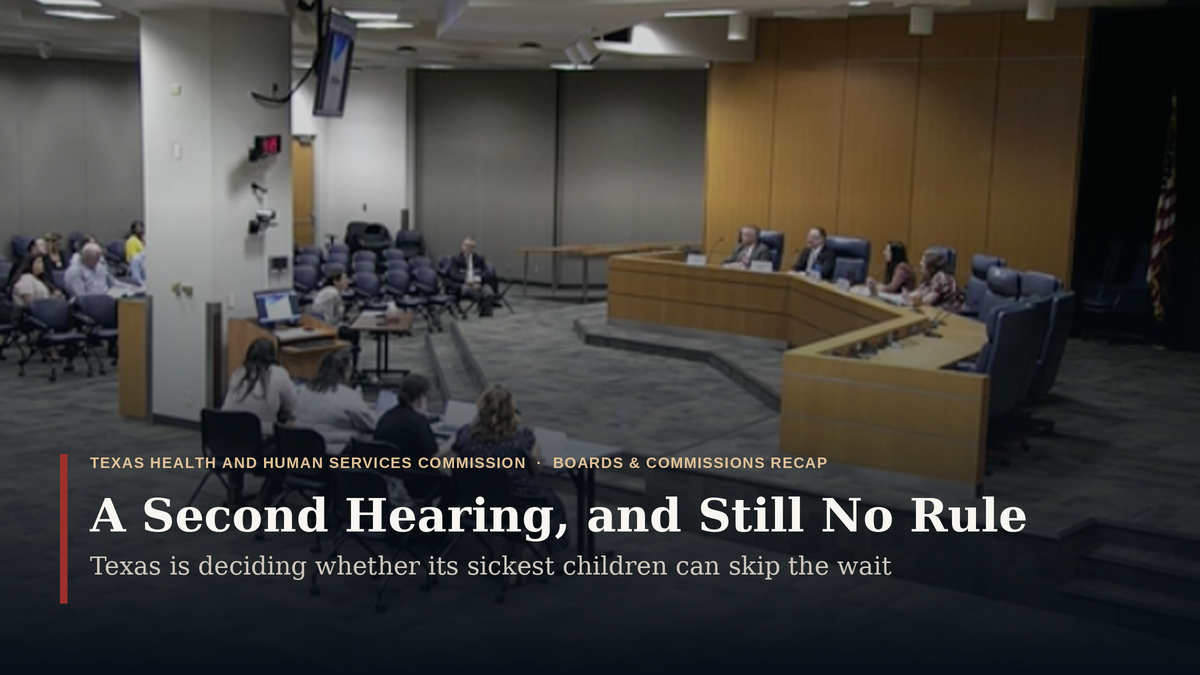
The rule that would let the most medically fragile children in Texas get Medicaid nursing care at home — without first moving into a nursing facility, and without waiting their turn on a list — has now been through two public hearings and still has not been adopted. The second was Oct. 12, three weeks after the written comment period closed.
The waiting list is why the rule exists. The commission counted 7,239 children on the interest list — the state’s term for a waiting list — for the Medically Dependent Children Program as of July 31. The program is a Medicaid waiver: federal permission for Texas to pay for nursing care in a child’s home instead of a nursing home.
Reaching the top of that list, though, is not the same as getting in. Of 4,630 children released from the list between Sept. 1, 2025 and July 31, the commission logged 798 as enrolled and 3,173 as denied, declined or withdrawn, with 640 more in process. That is roughly one enrolled for every six released — the Dispatch’s own arithmetic on the agency’s July file, whose footnotes warn a child can fall in more than one category.
Emily Zalkovsky, the state’s Medicaid director, told a House committee in May — describing about 2,500 enrollments against nearly 15,000 denials, declines and withdrawals across all six lists in the previous budget cycle — that the number to watch was not the length of the lists.
“The majority of people are not getting enrolled because they’re not eligible, they decline, we can’t find them, one of those reasons. Not to say there’s not a lot of need, but that take-up rate is important to understand.”
The lock on the side door is clinical. The commission’s case is that the slots would let such children reach services “immediately, without having to go through the interest list process or enter a nursing facility”. A child has to be “too medically fragile to complete a stay in a nursing facility”, one of the new places held open outside the list — an “available diversion slot” — has to exist, and the child has to meet two or more of twelve conditions — among them a ventilator that breathes for the child, kidney dialysis, round-the-clock oxygen, all nutrition by tube or by vein, hospice, a recent transplant, and repeated hospitalizations for seizures that will not stop. A child who misses the mark is not turned away automatically: a review nurse routes the file to an agency physician, who decides on medical judgment. The Dispatch reported the filing in August.
That physician step matters because of the first hearing, on March 26. KERA reported then that the draft listed eight qualifying conditions and that doctors were losing the ability to flag a child as medically fragile without matching the checklist. Dr. Glen Medellin, a UT Health San Antonio physician in pediatric palliative medicine, called it long overdue and then objected: “I am concerned that we drop some criteria such as immunosuppression”, which he said covers children with cancer and stem-cell transplants. The version that reached October has twelve conditions and the physician route in it, but still no immunosuppression criterion — only the narrower “solid organ or stem cell transplant within the last twelve months”.
The objection the published text does not answer is about what counts as a crisis. Michael Clarke, deputy director of public policy and advocacy at the Arc of Texas, a statewide advocacy organization for Texans with intellectual and developmental disabilities, argued in March that two high-acuity diagnoses was the wrong test.
“Medically fragile children often have complex overlapping needs that do not fit neatly into rigid categories.”
He asked the commission to weigh a family’s circumstances too — a caregiver who cannot keep going, private-duty nursing lost. The published list is diagnoses only. Both objections were aimed at the March draft: no organization or official has gone on the record about the version that reached October.
What the rule still does not say is how many diversion slots there are: it authorizes them and does not count them. The commission reports no foreseeable cost implications for “state or local governments” and “no assumed change in future legislative appropriations”. A proposed Texas rule is “withdrawn six months after the date of publication of notice of the proposed rule in the Texas Register” if the agency has not adopted or withdrawn it first (§2001.027). For this one that falls on Feb. 21.
There was nothing else on it. The posted agenda ran to five lines: welcome and call to order, the hearing itself, a staff overview presentation, public comment, adjourn. A public hearing on a proposed rule takes comment; it does not act, and there was no vote to report. A quieter deletion in the same filing. The amendment also strikes the Medicaid Buy-In for Children Program — which lets families above the ordinary income limit pay a premium for coverage — from the list of financial routes into the waiver, saying only that the change is “for consistency with existing eligibility policy”. The cost ceiling stays. The rule keeps the long-standing limit that a child’s home care plan may not exceed 50 percent of what that child’s nursing facility care would cost without commission review and a draw on state general revenue — a cap that sits awkwardly beside a rule aimed at the children with the heaviest needs.