
A Hill Country landowner group is asking the judges weighing a 370-mile power line to consider new evidence before they recommend where it should run — a recommendation expected within weeks.
The Hill Country Preservation Coalition filed what is called a motion to reopen the record on July 13. In plain terms, it asks the state administrative law judges hearing the case to take in more evidence even though the hearing itself ended in May. The filing landed in Public Utility Commission Docket 59336, the application by AEP Texas and CPS Energy, San Antonio’s city-owned utility, for state permission to build the Howard-Solstice transmission line. As of Monday it was the newest filing in the case, and neither the utilities nor commission staff had answered it.
The judges heard the case May 19-22, the parties filed their final written arguments June 1, and the last order in the case came May 26. The judges are expected to deliver their recommendation — a document called a proposal for decision — in late July, according to a case summary kept by Harrison Davis Morrison Jones, a Waco firm that represents landowners in these cases. The commissioners then vote. State law gives them 180 days from the March 2 application, which puts the deadline at Monday, Aug. 31.
Running alongside the question of where the line goes is a bigger one: whether it is needed at all.
American Stewards of Liberty, a property-rights group, asked on June 5 that regulators hold off on settling the need question for the whole Permian Basin package until a companion case, Docket 59475, has been fully argued. Nine landowners filed in support over the next two weeks, and a group of state legislators filed a brief backing the request on June 15. The utilities opposed it on June 12, and on June 24 the four companies building the Permian lines — LCRA, CPS Energy, Oncor and AEP — filed their own answer to the lawmakers.
Much of that has already been decided elsewhere. As The Texas Dispatch reported, the commission refused on June 17 to postpone the need question across all the lines, pausing one segment instead to wait on a companion case. The need question had already been moved to Docket 59475 by the judges in a separate scheduling decision, SOAH Order No. 24, so that one ruling could cover a question common to every line in the plan. That earlier report counted 43 lawmakers on the brief — 34 House members and 9 senators. The Docket 59336 file shows no ruling on the American Stewards motion as filed in this case.
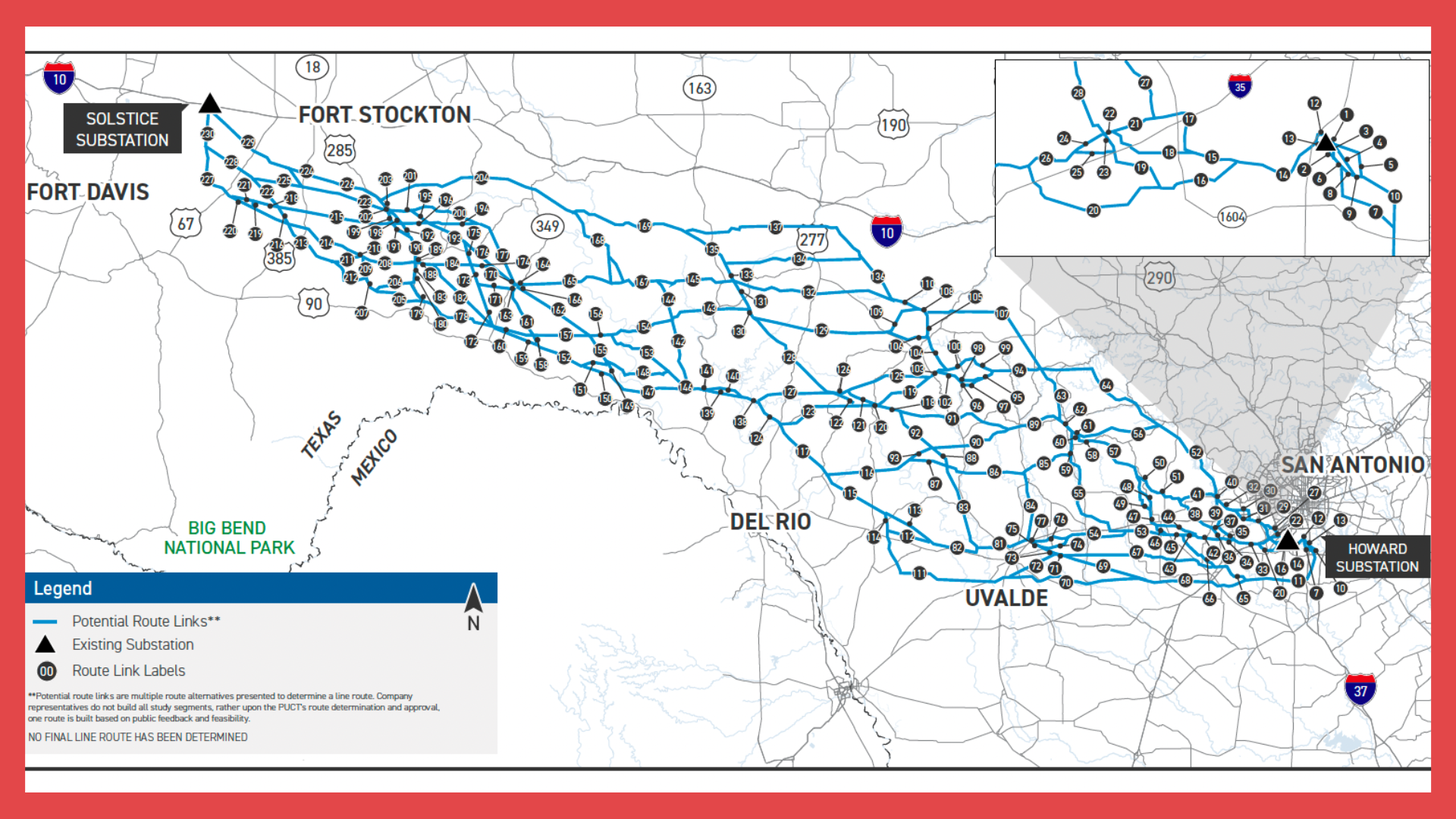
What is being fought over is unusually big. The line would carry 765 kilovolts, the highest-capacity design built anywhere in the country, for about 370 miles from CPS Energy’s Howard Road Station in Bexar County to AEP’s Solstice Station in Pecos County, crossing 14 counties from the San Antonio suburbs to the edge of the Permian Basin.
The utilities mapped 77 possible routes; they and commission staff both favor the one labeled Route 4. AEP has said the towers would stand 140 to 160 feet tall, spaced roughly 1,400 feet apart, on strips of land at least 200 feet wide. An Energy Ventures Analysis study prepared for the Texas Public Policy Foundation put the cost of this line alone near $1.4 billion; ERCOT has estimated the full set of Permian lines and related upgrades near $13.8 billion.
The utilities say West Texas cannot wait. ERCOT’s board endorsed the Permian project in July 2024 saying it is critical to keeping the grid stable, and the commission approved the 765 kilovolt design in April 2025, CPS Energy said on its project page. The whole effort traces to House Bill 5066, a 2023 law by Rep. Charlie Geren ordering up a plan to get more power into the oil patch.
The coalition says its quarrel is with the route, not the grid. It wants the line moved away from what it calls “pristine lands, delicate upper river basins, and major recharge and contributing zones of the Edwards Aquifer,” according to its project page. The group, based in Utopia and organized across six counties, argues the towers would hurt a local economy built on tourism and hunting, lower property values, cut through migratory bird and butterfly routes, spoil dark skies and disturb historic sites.
The commissioners are not bound by what the judges recommend. They can accept it, change it, or choose a different route altogether.