
With the 2025-26 school year now complete, Texas has finished the first full year under House Bill 1481, the statewide prohibition on student use of personal communication devices during the school day, and the early assessments from educators, teacher groups, and researchers point in the same general direction: noticeably calmer campuses, with the harder questions about discipline and academic results still unresolved.
The law, passed by the 89th Legislature, took effect June 20, 2025, required every district and open-enrollment charter to adopt a written policy by September 18, 2025, and made 2025-26 the first year of enforcement, according to the Texas Education Agency’s implementation guidance.
Under the statute, school districts must bar students from using cell phones, tablets, smartwatches, and similar devices on campus during the day, choosing either to prohibit the devices outright or to require secure storage, the TEA guidance states. To help cover storage costs, the agency administers a $20 million Phone-Free Schools grant program, with priority for rural and socioeconomically disadvantaged systems. Districts adopted a range of approaches, from locked pouches collected each morning to rules requiring phones to stay out of sight in a backpack.
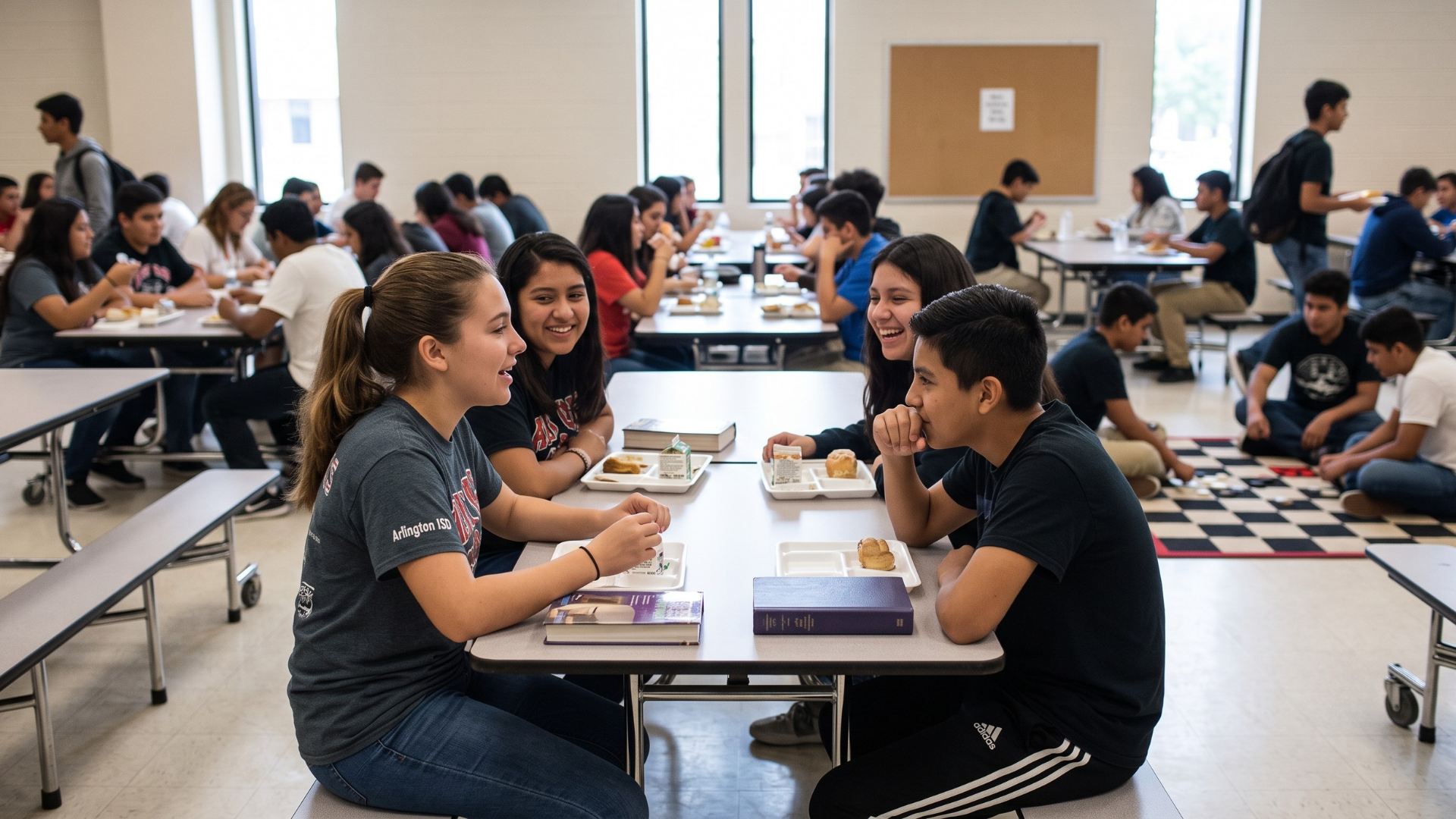
District leaders have described the change as a clear improvement in school climate. Arlington Independent School District Superintendent Matt Smith told the Fort Worth Star-Telegram that teachers report spending less time managing distractions and that students who once spent lunch periods on their phones now talk with one another, recounting a principal who found students playing on a life-size checkerboard in the cafeteria.
Smith said the district intentionally adopted a relatively strict version of the policy in year one for clarity, but may revisit it to determine what limited classroom uses—such as photography for yearbook classes or grammar tools in English classes—state law might allow. He added that schools and parents still need to teach young people responsible technology use, since most students turn their phones back on the moment they leave campus.
Teacher sentiment has run largely favorable. In an informal survey of Texas Classroom Teachers Association members reported by the association, about 75 percent of respondents said they fully supported the ban, while most of the remainder said they somewhat supported it but favored allowing phone use during non-instructional time or in emergencies.
At a May 11 interim hearing of the Texas House Public Education Committee, school leaders offered generally positive feedback, with one librarian noting that book circulation had risen since the ban took hold, according to accounts from Texas AFT and the TCTA; some panelists pressed for flexibility so high schoolers could use devices as part of workforce and college-readiness training.
Researchers caution that measurable academic gains may not appear immediately. In a working paper distributed by the National Bureau of Economic Research, University of Rochester economist David Figlio and other researchers examined an urban Florida district that has restricted school cell phone use since 2023 and found a rise in in-school suspensions in the first year, followed by a return to roughly normal levels in the second year alongside modest improvements in state test scores and attendance.
Figlio cautioned against drawing sweeping conclusions from a single study while noting that the evidence so far suggests districts that adopted bans “made the right move.”
Not all observers favor the state mandate. Texas Policy Research has argued that the statewide ban oversteps and that decisions about student phone use are better left to parents and local districts, a critique that frames the policy as a question of authority rather than effectiveness.
The forward-looking questions now turn on data the state has not yet released for the full year: district-level enforcement and confiscation figures, how the $20 million in storage grants was distributed, and whether the reading gains the TEA associated with phone restrictions in its spring STAAR results hold up as more outcomes are reported. Science results for grades 5 and 8 are due July 31, and statewide A-F accountability ratings are expected in August.