
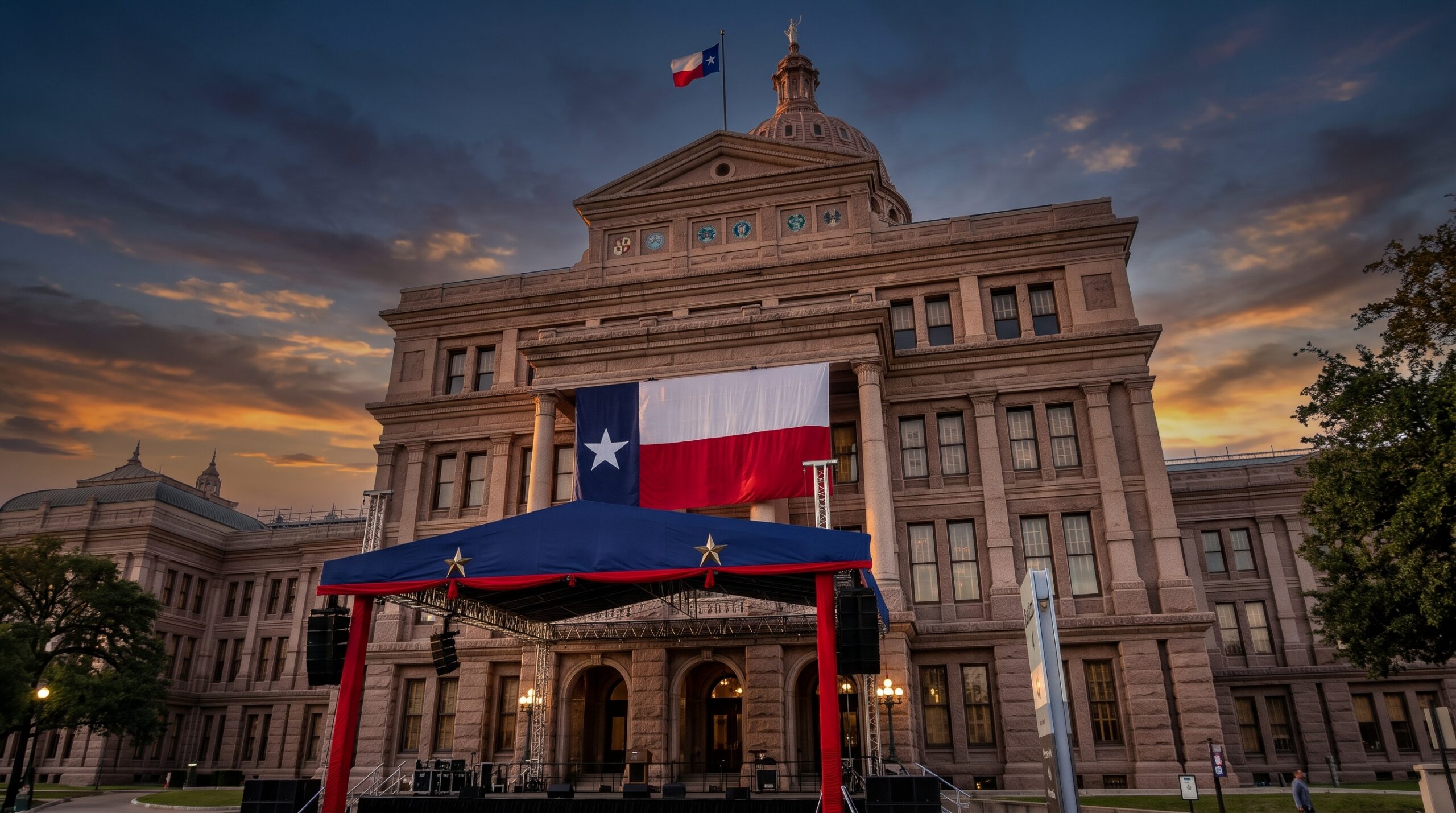
Texas pays for most of its governor’s inauguration with private donations, under a state law first passed in 1987. Each of the last three inaugurations raised between about $4.5 million and $5.3 million, much of it from corporations and private donors, according to news accounts. The next round starts this week. The secretary of state must name Gina Hinojosa governor-elect by Nov. 13, and that triggers the formation of her inaugural committee.
Why it matters: the inauguration is the first major fundraising effort of every new administration. The law decides who can give, how much, and how much the public learns about where the money went. The same rules have applied to governors of both parties for nearly four decades.
The law works in steps. Within 10 days of the election, the secretary of state issues a proclamation naming the governor-elect and lieutenant governor-elect. The governor-elect then names a chair and a co-chair of the inaugural committee, and the lieutenant governor-elect, Vikki Goodwin, names a second co-chair. Anyone who holds a paid state or federal post is barred from serving. As of Nov. 9, the secretary of state’s news page listed no proclamation.
The statute treats an inaugural gift differently from a campaign contribution. It says such a gift “is not a political contribution for purposes of state law regulating political contributions or prohibiting a contribution by a corporation or labor organization.” That means corporations and labor unions, which cannot give to Texas campaigns, can give to an inauguration. The statute sets no limit on the size of a gift. The secretary of state must keep a public, alphabetical index of donors showing each donor’s name and mailing address, the date and the amount.
Disclosure of spending is narrower. By June 30 of the inaugural year, the committee must file a final report, verified by a certified public accountant, that shows three totals: money raised, money spent from private funds, and money left. The law does not require that report to itemize spending.
Gov. Greg Abbott’s first inauguration in 2015 raised more than $4.5 million, organizers told NBC 5. His 2019 inauguration raised a record $5.3 million. The 2023 inauguration of Abbott and Lt. Gov. Dan Patrick raised $4,651,350 from 136 donors, The Texas Tribune reported. Its largest gifts were $250,000 each from Fertitta Entertainment and Energy Transfer and $150,000 from H-E-B. The donor list was released more than five months after the event.
The Tribune sued the 2019 committee under the Public Information Act and obtained its ledger in a settlement. The records showed $1.7 million for George Strait and his band, about $899,000 in payroll and about $908,000 in fundraising commissions. Another $800,000 in unspent money went to 31 charities. The Tribune’s review found that payroll, contractors and fundraisers took a growing share of the money over time. That share was 5.7% in 1983, under Democratic Gov. Mark White. It was 10.6% in 1991, when Democratic Gov. Ann Richards took office, and 35% in 2019.
Supporters of the current system say private money keeps the cost off taxpayers. The 2023 committee said it “fully compensated the State of Texas for all inauguration-related expenditures,” according to the Tribune. Critics want more disclosure. Bill Aleshire, the Austin lawyer who represented the Tribune in its 2019 suit, told the paper, “We just don’t have that level of transparency written into the law.”
The new administration’s other early costs fall outside that law. The chapter does not mention a governor’s transition. Hinojosa’s transition website, governorhinojosa.com, says it is paid for by her campaign, which is subject to campaign-finance rules. On Nov. 5 she named Joe Madden, a former chief of staff to Harris County Judge Lina Hidalgo, as transition executive director. Former Republican state Rep. Ernest Bailes and Ryan Pollock of the Texas State Building and Construction Trades Council are co-chairs. The Dispatch previously examined what a governor can do alone and what requires the Legislature.
Bill prefiling for the 2027 session opened Nov. 9, and any change to inaugural rules would need a bill. The secretary of state’s proclamation is due by Nov. 13. The Constitution sets the swearing-in for the first Tuesday after the Legislature organizes, which would be Jan. 19.
Key facts
- Nov. 13, 2026: Deadline for the secretary of state to proclaim the governor-elect and lieutenant governor-elect (Government Code §401.001).
- Inaugural gifts may come from corporations and labor unions, with no statutory cap; the secretary of state keeps a public donor index (§401.004).
- The CPA-verified final report, showing totals only, is due June 30, 2027 (§401.008).
- Recent inaugurations: more than $4.5 million (2015, NBC 5); $5.3 million (2019); $4,651,350 from 136 donors (2023, Texas Tribune).
- 2019 spending, per records the Tribune obtained: $1.7 million for entertainment, about $908,000 in fundraising commissions, $800,000 to charities.