
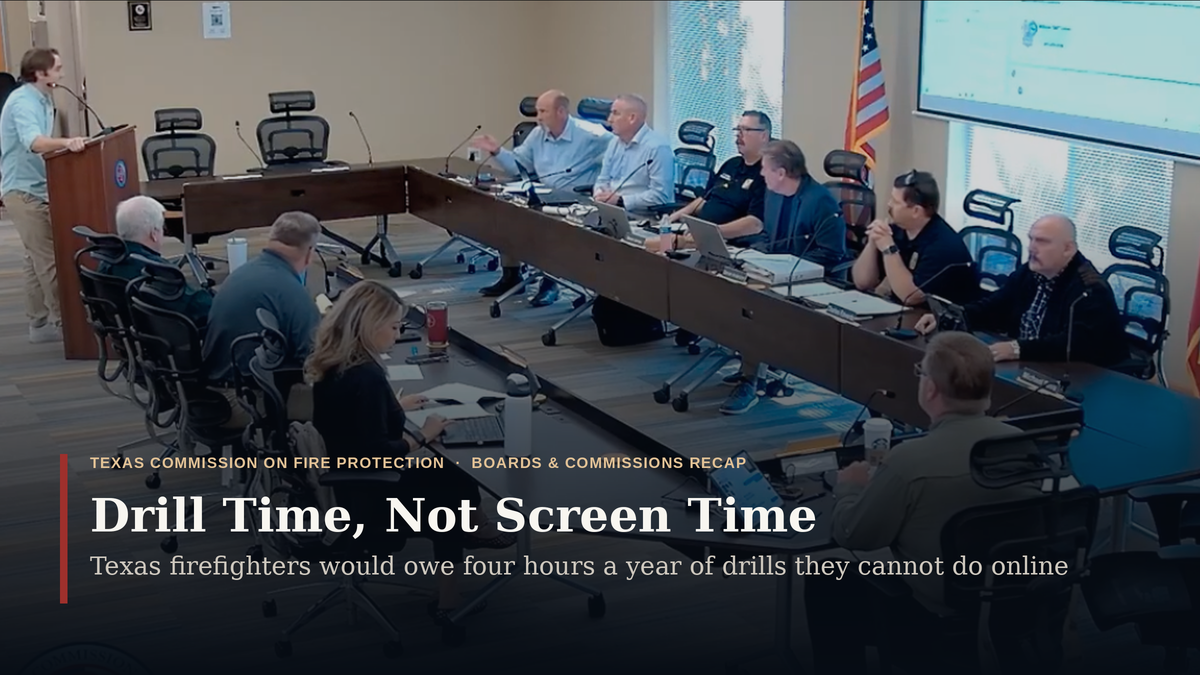
Texas firefighters would have to spend at least four hours a year actually pulling hose, throwing ladders and working in an air pack — not clicking through modules on a station computer — under a rule change the state’s firefighter advisory committee took up Sept. 24.
The state asks for two hours now, and it does not say how a firefighter gets them, which is how they end up being satisfied at a keyboard. A working group of the committee wants to double the number and close that door: all four hours would have to be documented hands-on work and “shall not be satisfied solely through online or classroom instruction” — language Daniel Anderson, a Cy-Fair fire officer who sits on the committee, read aloud to the room.
The Texas Commission on Fire Protection certifies about 37,000 individuals and regulates 884 fire departments. The four hours would not reach all of them. The requirement would fall only on firefighters certified for structure fire protection. Left out deliberately, Anderson said, are “individual certificate holders, retirees or other administrative personnel” who keep a state card without riding a truck.
The commission’s own data complicates the case for ordering up more drilling. Its 2025 injury report counts 3,521 firefighter injuries statewide, and training was the largest single non-emergency source of them at 672, behind 745 hurt on fires. Mandating more hands-on hours means more hours spent in the activity that already sends the second-most Texas firefighters home injured.
The argument on the other side is that the realistic alternative is not drilling at all. The chair, Daniel DeYear, said the committee hears it from the field.
“We’ve all heard from firefighters out there saying I’m not getting any drill time. … we’re clicking buttons on the computer, but not getting out there and putting our hands on equipment.”
Anderson told the committee the working group deliberately moved the requirement out of the general 18-hour continuing-education pool and into the suppression rule (§441.7), because muscle memory decays when a department leans on computer-based training. The language proposes what would count under the new rule: mayday and self-rescue drills, inspecting and testing an air pack, and “core fire ground skills such as hose, ladders, and related operations.”
Whether departments could document any of that was the open question in the room. An agency compliance official said it would not be much added work — “I don’t think it’s going to be a burden per se because our compliance officers already review CE records.” He told the committee to write it tightly anyway. Leave the term loose, he said, and firefighters will satisfy it by walking outside and putting a wrench on a hydrant.
No union, fire chiefs’ group or trade association has taken a public position on the proposal. The nearest outside evidence is a survey of more than 1,300 firefighters published Sept. 17 by the trade outlet FireRescue1, which found respondents asking for repetitions rather than lectures; one wrote simply, “Stop talking. Give me reps.” The same survey cuts against a state mandate as well: asked what stops them training, firefighters named short staffing, call volume, money, and the lack of towers and props to train on. A rule supplies none of those. The survey is national, self-selected and takes no position on what Texas should do.
A hands-on requirement would not be new to the rulebook — firefighters holding a wildland certification already owe four hours a year that include a hands-on fire shelter drill. What is unusual is that neither of the working group’s recommendations appears in the posted meeting materials. The notebook for Sept. 24 carries only the rules as they stand, and both were read from a handout passed around the room, which leaves the video as the sole public record of the wording.
Both items were tabled without going to the commissioners. The advisory committee, the curriculum and testing committee and the health and wellness committee sit down together Oct. 7 — “this is the first time the three committees have ever had a joint workshop”, the chair said — and the advisory committee returns to continuing education Dec. 3. Whatever it settles on still has to clear the full commission before it binds a single firefighter.
A second look at what the master firefighter rank should cost. Before the continuing-education item, the committee spent nearly half an hour on whether the state’s top firefighter rank is too easy to reach. The rank now takes 12 years plus college credit, and members argued over whether paramedic training and fire officer coursework should count for firefighters who never went to college, and whether time served alone proves anything. Bill Crews, of the Garland Fire Department, moved to table it for members to draft alternate language. Two rule reviews cleared on grammar alone. The committee sent the certification curriculum manual and the administrative inspections and penalties chapters on to the commissioners with no substantive change — only capitalizing the word commission and hyphenating commission-approved throughout. The state’s new efficiency office has the fire rules. Staff told the committee the Texas Regulatory Efficiency Office, created in the 2025 session, has already reviewed the agency’s rulebook and returned suggestions, and that some chapters may come back for another pass.