
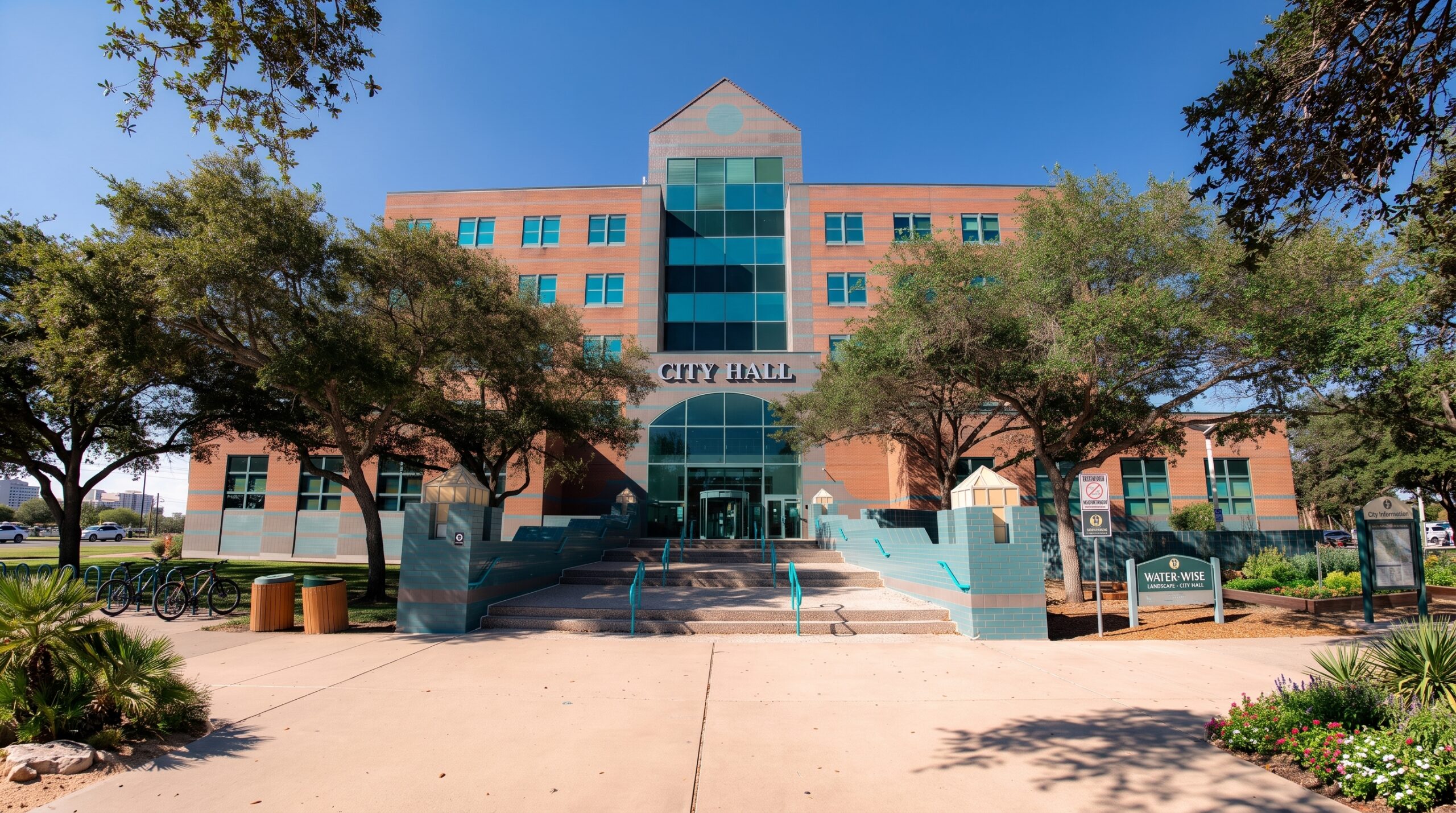
Corpus Christi’s city council set its property tax rate on Sept. 8 at $0.599774 per $100 of value — the identical rate it charged last year, to the sixth decimal place. The motion failed on a 4-4-1 vote. The council reconsidered it later in the same meeting and passed it 7-1-1.
The reason a rate that did not move needed a supermajority is the single most misunderstood thing about Texas property taxes, and it is about to be on display in more than a dozen of the state’s largest cities and counties in the space of five days.
Under Section 26.05(b) of the Texas Tax Code, a city or county adopting a rate that brings in more money than last year’s rate would have brought in from the same properties must take a record vote, and “at least 60 percent of the members of the governing body must vote in favor.” The benchmark is called the no-new-revenue rate — the rate that would raise the same amount from the same properties as the year before. Corpus Christi’s was $0.596985. Holding the rate flat while property values rose put the city 0.50 percent above it, and the city’s own ordinance says so on its face: “which is effectively a 0.50% increase over the no-new-revenue tax rate.” Four of nine members is 44 percent. Seven of nine is 78 percent.
The lesson runs in both directions, and this week’s calendar shows it.
Arlington’s council votes Sept. 15 on a rate of $0.636334, up from $0.629800 — and the average homestead bill falls, from $1,574.22 to $1,515.62, a drop of 3.72 percent, because average taxable value in the city fell 4.72 percent. The rate Arlington is adopting is exactly its no-new-revenue rate. Midland shows the same mechanism more starkly. Its taxable base shrank by $1.69 billion, from $23.17 billion to $21.47 billion, so the rate that merely holds revenue even runs roughly a tenth higher than the rate on the books. The average Midland homestead lost 8.59 percent of its taxable value, and the average city bill rises all of $6.50 — from $1,038.18 to $1,044.68, six-tenths of a percent.
Plano goes the other way. Its council votes Sept. 14 on $0.437600, a rate that has not changed, but which sits 1.01 percent above the city’s $0.433220 no-new-revenue rate. The median Plano homestead went from $452,109 to $464,574, and the bill goes from about $1,978 to about $2,033. Because the rate exceeds the benchmark, Plano must also pass a separate resolution ratifying the increase.
Cameron County is the sharpest case of all. The county held its rate at $0.424393, far below its no-new-revenue rate of $0.545920 — and the average homestead bill still climbs from $645.20 to $703.04, up 8.96 percent, entirely on rising values.
Some jurisdictions are plainly raising taxes and saying so. Lubbock adopted $0.513421 on Sept. 8 against a no-new-revenue rate of $0.475154, about 8.1 percent above, with the increase funding police and fire contracts and adding $99.87 to the bill on a median homestead, by the city’s own taxpayer impact statement. Austin adopted $0.579948 in August against a no-new-revenue rate of $0.535466, about 8.3 percent above — the steepest margin among the big cities.
Others are cutting. Mesquite adopted $0.654018 on Sept. 8, down 7.19 percent and its lowest rate since 2016. Frisco, which floated an increase in August, directed staff at a Sept. 2 work session to hold flat at $0.425517 instead, and votes Sept. 15; that would be a ninth consecutive year without an increase.
The heaviest day is Sept. 17. Fort Worth votes Sept. 15; Dallas votes Sept. 16 on $0.697800; San Antonio votes Sept. 17; and Harris County votes the same morning on four separate rates at once — the county at $0.417500, the flood control district at $0.052660, the hospital district at $0.195280 and the Port of Houston Authority at $0.006030, according to the 647-item agenda the county published at 3:34 p.m. Sept. 11. Harris County’s no-new-revenue rate is $0.386670, per the worksheet its tax assessor-collector, Annette Ramirez, signed Sept. 3. The Dispatch reported where the county’s proposed rate sits against the legal ceiling after commissioners advanced it Sept. 8. The court’s Oct. 6 meeting is canceled, leaving Sept. 17 as the last scheduled date before the fiscal year turns.
Bexar County votes Sept. 15 on a rate its commissioners have described only as “just under 30 cents.” The exact figure is not published anywhere the public can reach it.