
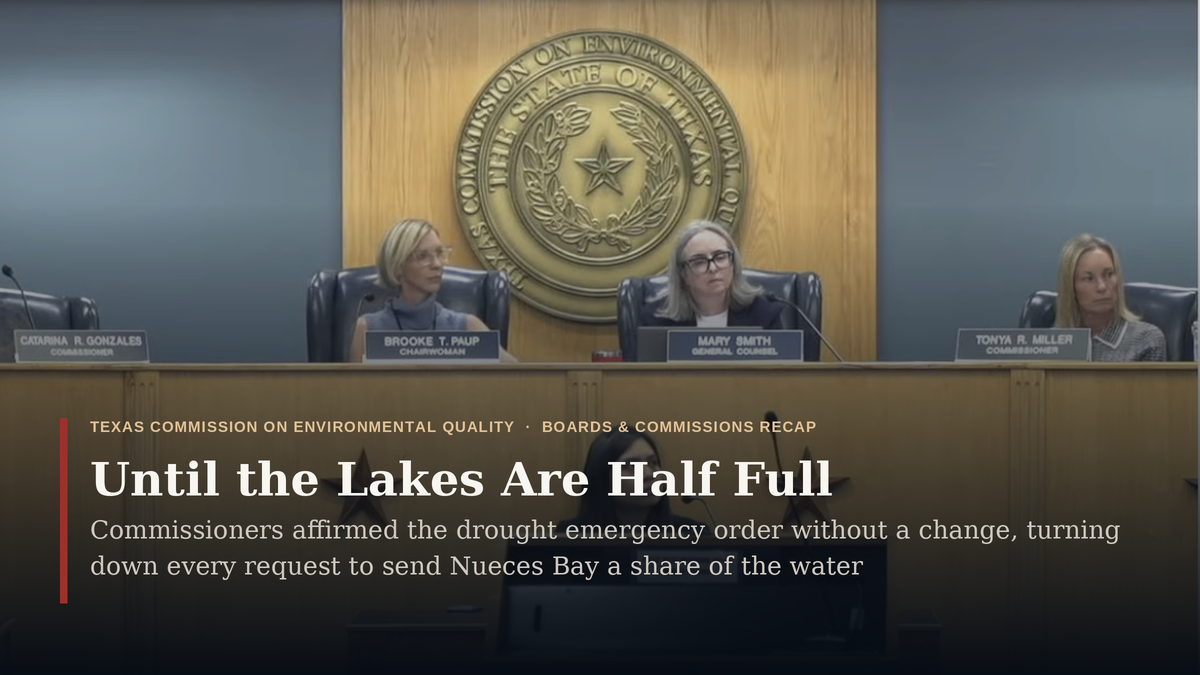
Corpus Christi can continue holding back the fresh water it owes Nueces Bay until its reservoirs are half full, Texas environmental regulators decided Sept. 9, affirming a drought emergency order without changing a word.
What the bay loses is disputed. The Coastal Bend Bays & Estuaries Program, a nonprofit that monitors the estuary, told the commission that salinity in Nueces Bay, normally 22 to 26 parts per thousand, passed 40 before spring rains, and that the marsh behind it — nursery habitat for fish, shrimp and crabs — went above 55, saltier than the open Gulf. On the other side is the supply for the half a million customers the city’s lawyer said it serves.
The order, signed Aug. 25 by Executive Director Kelly Keel, suspends a condition on a water right held jointly by the city, the Nueces River Authority and the town of Three Rivers. It requires water to be sent downstream whenever the two reservoirs, Choke Canyon and Lake Corpus Christi, are at or above 30 percent full together. The order lifts that line to 50 percent, which keeps the water where it is. The hearing was not discretionary: state law requires one within 15 days of an emergency suspension, and Sept. 9 was the fifteenth day.
Nobody asked the commissioners to throw the order out. Nathan Vassar, who told them he represents the city, said the law asks only whether an emergency exists and whether it can be solved another way.
“We are not obligated to show some perfect amount of water that would be saved. Every drop counts.”
The commission’s acting public interest counsel, Eli Martinez — the office inside the agency that speaks for the public — backed the order. Combined storage hit an all-time low of 7.7 percent in May, he said, and stood at 40 percent that morning, with Choke Canyon at 24 percent against 91 percent at the smaller Lake Corpus Christi. New groundwater and brackish supplies are years off, and “conservation reduces demand but obviously does not create supply.” Nineteen months without releases, he added, had produced no documented evidence of fish kills. State Rep. Denise Villalobos said the releases had driven her constituents’ tap water to the point that households were getting notices about arsenic and dissolved solids, and that a child was hospitalized — an account the Dispatch could not verify.
Three groups and a retired official asked the commission to narrow the order instead. None got anything. Their sharpest point was arithmetic. The order’s headline volume is about 36,500 acre-feet — roughly 12 billion gallons — that would otherwise go downstream over its term. Adrien Hilmy, a project manager at the bays program, said that number sums monthly targets rather than water the city must actually release, because rainfall, return flows and spills over the dams all count toward it. Between 50 and 30 percent capacity, he said, the August-to-January requirement has averaged about 12,800 acre-feet.
“When capacity is between 40 and 30%, required releases during this same period average about 4,300 acre feet, not the 36,500 stated in the application.”
Storage sits near the boundary between those bands. Nobody asked for the full 36,500 either; Kiersten Stanzel, the program’s executive director, said so outright, arguing for a smaller volume steered to the delta. No commissioner took up the discrepancy, and the staff who recommended affirming did not answer it. The Dispatch has itself printed the 36,500 figure.
Texas’ fish and wildlife agency took no side. Writing to Keel on Aug. 21, four days before the order existed, its executive director said that if one were granted it should run no longer than the 120 days requested, with the commission reassessing conditions before extending it, as the Dispatch reported Aug. 31. The affirmed order does run 120 days. It then extends itself another 60 on a storage number alone, with no further meeting — a design Commissioner Tonya Miller defended against commenters who called it automatic, saying it is “a conditional renewal for 60 days based on the conditions in the reservoirs at that time.”
All three commissioners said they would affirm, and the motion passed. Nobody from the shrimping or oystering industry spoke. Two who did raised the one thing the dais never answered: the order finds the city in Stage 2 of its drought plan, a moderate shortage, but it moved to the milder Stage 1 on Aug. 27, two days after the order was signed.
Jay Kleberg of Gulf Trust asked that Stage 2 be restored as a condition of relief; Myron Hess, for the National Wildlife Federation, noted the city’s own reading of conditions. No commissioner responded. The suspension runs to Dec. 23, and to Feb. 21 if the reservoirs stay below half — the end of winter, without another vote.