
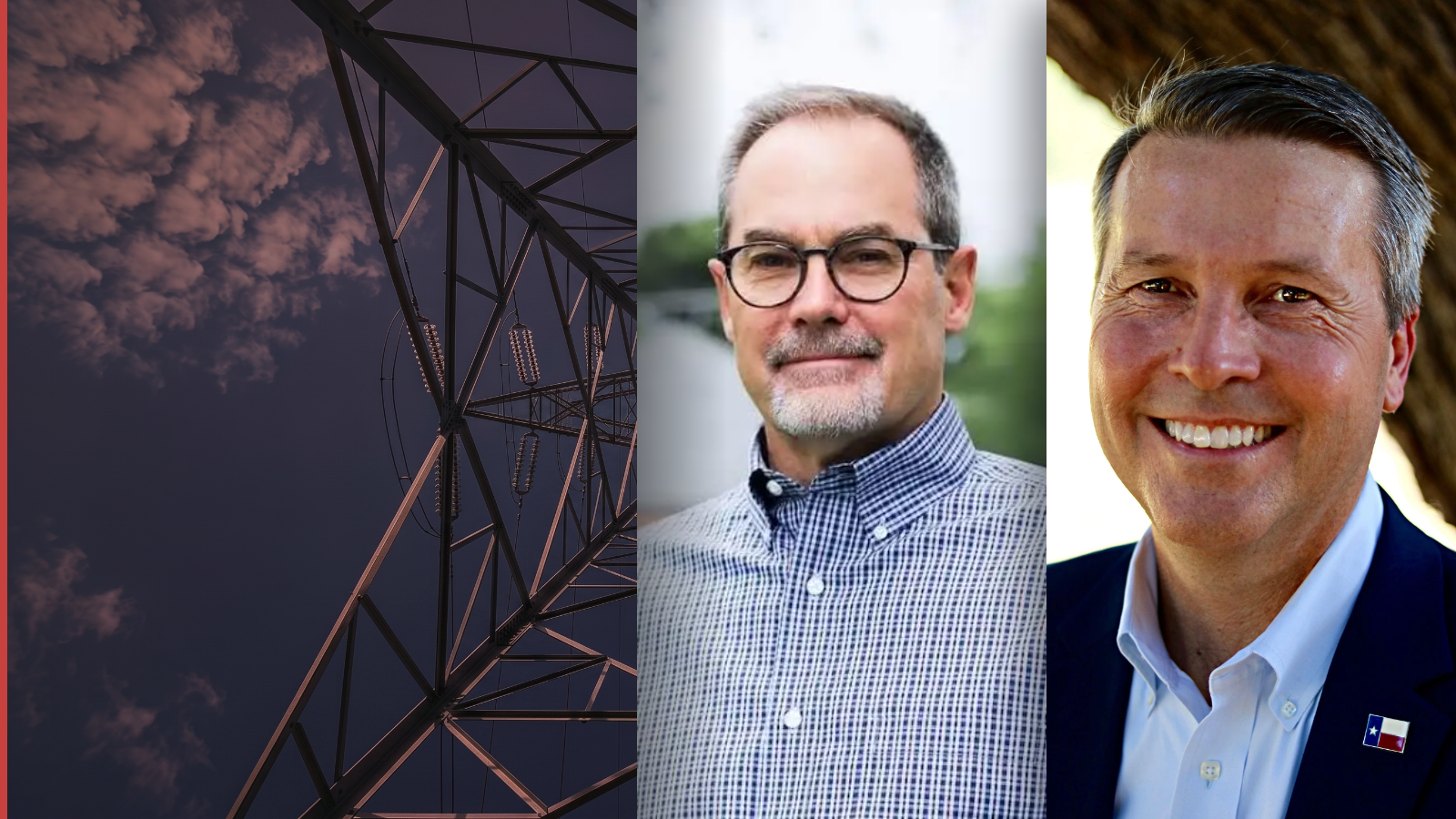
Two state lawmakers have formally asked the Public Utility Commission of Texas to hold off on a final decision on the Howard-Solstice high-voltage power line — and on every other 765-kilovolt segment of the state’s transmission plan — until after the Legislature meets in 2027, arguing the state has not tested whether cheaper alternatives could avoid the lines entirely.
State Senator Kevin Sparks of Midland and state Representative Brad Buckley of Salado laid out the request in a letter dated July 20 that was filed in the commission’s Howard-Solstice docket on July 21.
The Howard-Solstice line is one of three planned 765-kilovolt lines — that is, 765,000 volts, the highest-capacity transmission design built anywhere in the country — that make up the state’s Strategic Transmission Expansion Plan. That plan, in turn, grew out of the Permian Basin Reliability Plan, ERCOT’s blueprint for moving more power into the oil-and-gas-rich Permian region. Together the three lines would span more than 1,200 miles and cost an estimated $13.8 billion, according to the Electric Reliability Council of Texas, the operator of the state’s main grid.
Sparks and Buckley’s core objection is about assumptions. The 765-kV plan, they wrote, “is predicated upon an assumption that future generation in Texas will primarily be wind and solar, and it does not consider any alternative scenarios that involve more gas generation.”
They want ERCOT to complete “a full reappraisal” of the lines in its Regional Transmission Plan before December 2026, this time counting the 71 gigawatts of natural-gas generation now in the pipeline — up from the 22 gigawatts on the books when ERCOT finished the Permian plan in 2024. Gas in the queue in West Texas alone, they wrote, has grown from 4 gigawatts to 20, “far outpacing the roughly 6 GW of transfer capacity that the 765-kV lines could provide to the region.” They also asked the commission to study market changes that could draw that gas online and reduce the need for the lines.
The lawmakers acknowledged their request would push past the commission’s legal deadline. Under House Bill 5066, passed in 2023, regulators have 180 days to approve or deny a line of this kind — a window that, for Howard-Solstice, closes in late August. That shortened clock “makes sense for smaller projects,” they wrote, “but it does not make sense for massive cross-state transmission lines.” Both said they still support local upgrades within the Permian Basin and transmission that connects “reliable, consistent generation.”
The utilities building the line see it differently. AEP Texas and CPS Energy, the joint applicants, have pressed the case that the project answers a documented reliability need as oil-and-gas electricity demand in the region surges, and they have urged the administrative law judges hearing the case to keep the record closed and move to a decision.
On July 20 the two companies, joined by Uvalde County’s Briscoe Ranch, filed responses opposing a motion by the Hill Country Preservation Coalition — a landowner group fighting the route — to reopen the record, meaning to take in more evidence after the hearing ended in May. The coalition signaled on July 22 that it intends to file a reply.
Texans for Responsible Infrastructure Investment, a pro-transmission coalition answered the legislators letter on July 22. TRII said that a delay would raise costs, prolong reliability risk, and ask the fastest-growing region in Texas to wait for power it already needs — and that the letter’s central claims are already addressed by ERCOT’s existing analysis and planning record.
The commission has already slowed the case once, voting June 17 to pause — in regulatory terms, to “abate” — its decision on the first segment until it takes up the third, which it is expected to do in August. The judges’ recommendation, known as a proposal for decision, had not been filed as of July 22, the docket shows.
The pressure is building on more than one front. The state Senate Business and Commerce Committee has scheduled a public hearing for July 29 on the grid and on ways to blunt the 765-kV lines’ effect on private property — a session The Texas Dispatch previewed this week.