
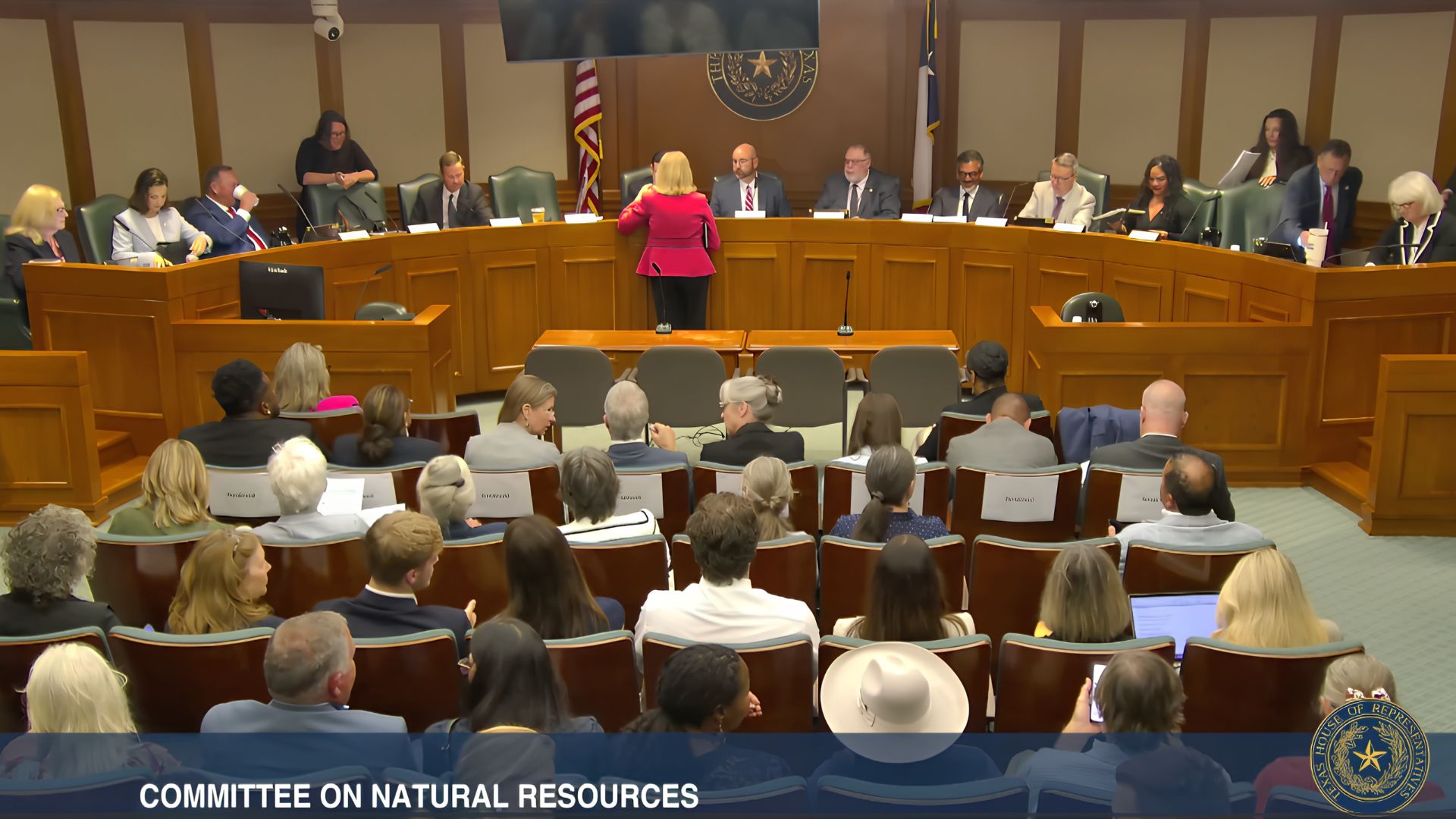
Texas is preparing to spend up to $20 billion on water over the next two decades. The early problem, state officials told the House Committee on Natural Resources on Tuesday, is not the money — it is that demand for it already runs far ahead of what the state can fund.
The Texas Water Development Board opened the interim hearing with a status report on the windfall voters and lawmakers have handed it. Administrator Bryan McMath said the board has about $1 billion in one-time appropriations to push out for water supply and infrastructure, divided into population-based “buckets” so that small rural systems and large utilities can compete for it without crowding each other out. Rep. Mary González, D-Clint, praised the agency’s “transparency” and called the appropriation “very timely.”
But the board’s central message was scarcity of capacity, not cash. Its flagship financing program, the State Water Implementation Fund for Texas, or SWIFT, is backing nearly $6 billion in projects, and the appetite for it keeps growing. The program has run “ten times” oversubscribed in recent years, the board reported, and “2026 was not any different.” “Available capacity does not keep pace with the identified project demand,” an official told members. A companion federal-state drinking-water fund is similarly stretched.
Members pressed on how the dollars actually move. Told that one $1.25 billion tranche flows as low-interest loans rather than outright grants, they asked who repays the money and on what timeline. The answers matter because the bulk of the new money is still to come — and is not guaranteed.
Officials walked through Proposition 4, the constitutional amendment voters approved in November, and Senate Bill 7, its enabling law. Proposition 4 dedicates up to $1 billion a year in sales-tax revenue to the Texas Water Fund, roughly $20 billion over two decades. Half of that is steered to the New Water Supply for Texas Fund, which backs “more innovative” projects — the kind that do not need to appear in the long-range state water plan. An official cautioned that the stream is “contingent not just on legislative appropriation, but also a robust economy,” because it depends on sales-tax collections holding up.
The stakes behind the spending came through in the planning numbers. Temple McKinnon presented the draft state water plan, which projects that Texas could face shortages of about 3.6 million acre-feet of water in the 2030 planning decade if nothing changes. The board is preparing a “phase two” amendment to the plan before a January 5, 2027 statutory deadline, McKinnon said — the document that will carry the agency’s formal legislative recommendations into the next session.
That timeline frames the year ahead. The board’s recommendations land just as the 90th Legislature convenes in 2027, and Chair Cody Harris, R-Palestine, said the committee will “focus largely on data acquisition for groundwater districts and groundwater in general” when it returns. Because the panel met in the interim, it took no vote; the testimony will shape water-finance and groundwater bills filed next year.
Also at the hearing
The committee spent most of its nearly 10 hours on a separate charge: the water consumed by data centers. Members heard that no agency regulates groundwater pumping outside a conservation district, pressed operators including Amazon Web Services on use and secrecy, and clashed over the NDAs that shroud data-center water deals.
__________________________________
When: 10:00 AM, Tuesday, June 23, 2026
Where: Room E2.036, Capitol Extension, Austin
Chair: Rep. Cody Harris, R–Palestine (HD-8)
Vice Chair: Rep. Armando Martinez, D–Weslaco (HD-39)
Key witnesses: Texas Water Development Board administrator Bryan McMath; Dan Diorio, Data Center Coalition; representatives of Amazon Web Services and other operators; conservation advocates including Rachael Haynes, Greater Edwards Aquifer Alliance
Archived video: house.texas.gov/videos/22709