
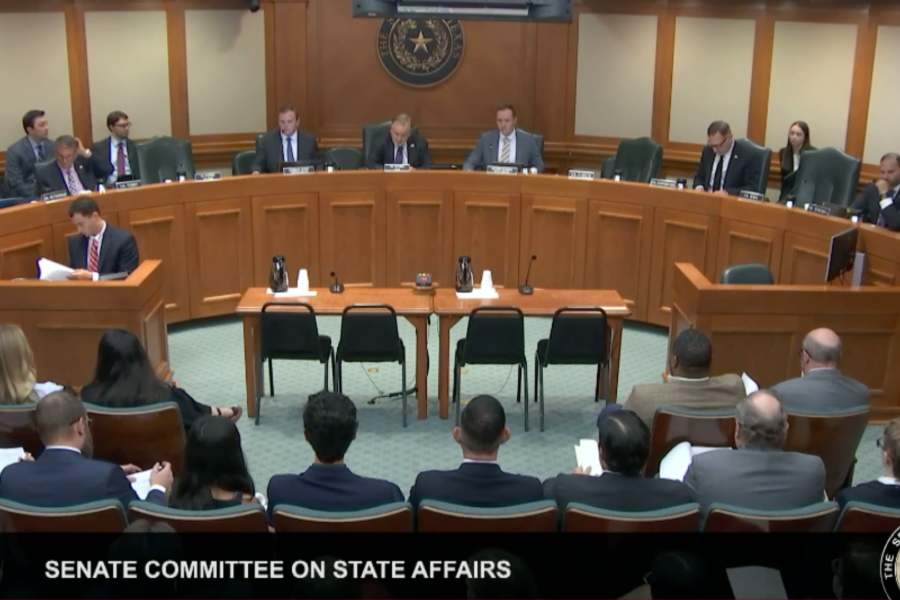
Texas election officials are reviewing all 254 counties to flag commercial mailboxes that may be standing in for home addresses on the voter rolls, the Secretary of State’s office told a Senate committee Tuesday. It was one of several roll-maintenance efforts that dominated the longest stretch of a marathon hearing on the security and efficiency of Texas elections, held as the state heads toward its next election.
The Senate Committee on State Affairs spent more than four hours on its two election charges — more time than it gave any other issue. Chair Bryan Hughes, R-Mineola, framed the security charge as the Lieutenant Governor’s directive to “strengthen the security of our elections, guarantee access for poll watchers,” scrutinize how counties run elections, and determine “whether anyone has attempted to circumvent the laws that the legislature has passed.”
Christina Adkins, the Secretary of State’s director of elections, led the panel and detailed a new list-maintenance push. “The other new list maintenance process that we’re about to roll out to our counties is a new process related to commercial mailboxes,” she said, calling it an issue that “has gotten a lot of attention over the last few months.”
Her office’s audit team will “by the end of the month” have “reviewed all 254 counties to identify potential commercial mailboxes,” she said, then hand each county a list of those addresses to check against its rolls. Adkins tied the effort to legislation by Sen. Paul Bettencourt establishing a confirmation-notice process for affected voters, and described separate procedures for confirming the addresses of voters who move within Texas or out of state.
Adkins also gave the committee a cautionary tale about election technology. A third-party voter-registration system used by some counties failed, she said: of 24 counties affected, 11 “ended up completely losing access to their data” and could not process registrations because their records sat in a system they could no longer reach.
She linked the disruption to the rollout of the state’s TEAM registration system. Military and overseas voters posed a different problem — many “in combat zones or hostile fire zones don’t have access to the mail,” making it hard to deliver them a ballot.
On the efficiency charge, members examined the methods counties use to mark and count ballots and the assignment of polling locations during party primaries. Not all the testimony cut the same way. Veronica Worms, testifying for the Texas Civil Rights Project, told the panel that “an efficient system is one where we have enough resources to execute the system, where everyone knows what they’re supposed to do, and where we have backup plans” for routine countywide problems — a framing that cast efficiency as a question of funding and administration rather than fraud.
Because the committee met in the interim, it took no vote. Hughes, a principal author of the state’s 2021 election law, said the testimony would inform recommendations for the 90th Legislature in 2027, where the commercial-mailbox process, the registration-system fallout and primary polling rules are all likely to return as legislation.
Also at the hearing
The committee opened the day on its monitoring charge, taking about 1¾ hours of testimony on Senate Bill 2337, the 2025 law regulating proxy advisory firms; witnesses accused the dominant advisers, ISS and Glass Lewis, of operating with too little transparency. It closed with roughly 3½ hours on enforcement against abortion pills mailed into Texas.
_________________________________
When: 9:00 AM, Tuesday, June 23, 2026
Where: Room E1.012 (Hearing Room), Capitol Extension, Austin
Chair: Sen. Bryan Hughes, R–Mineola (SD-1)
Vice Chair: Sen. Angela Paxton, R–McKinney (SD-8)
Key witnesses: Christina Adkins, Texas Secretary of State elections director; Brad Hubbard (Gibson Dunn) and James R. Copeland (Manhattan Institute) on proxy advisers; advocates including Avow and the Texas Civil Rights Project
Archived video: senate.texas.gov — State Affairs, June 23, 2026 (vid 22704)