
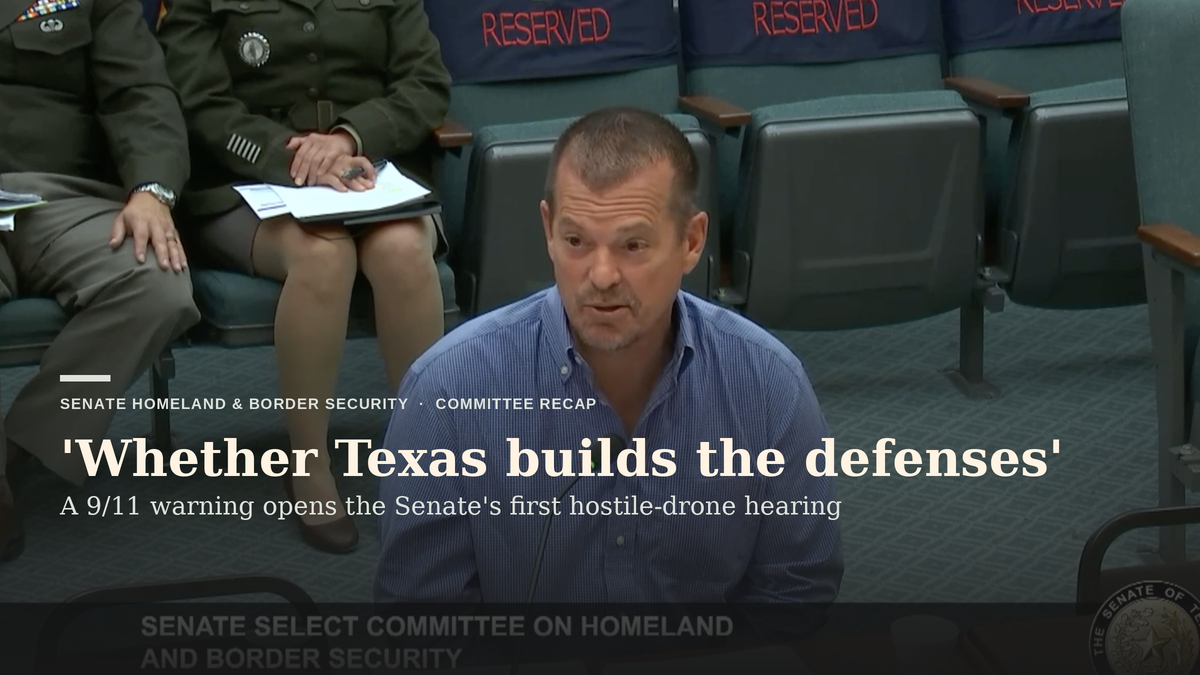
A drone expert opened the first hearing of the Senate Select Committee on Homeland and Border Security Wednesday with a countdown: “In security terms, today, August 12th is August 12, 2001. 30 days, our next 9/11 is coming,” Michael McGee, a Ph.D. and former fighter pilot, told the five-member panel. “The question is whether Texas builds the defenses before it arrives.”
Over roughly four and a half hours — about three-quarters of a nearly six-hour hearing — senators heard that cartels across the border field tens of thousands of drones, that 90 percent of DPS’ own fleet is built by companies owned in adversary nations, and that a brand-new federal law has handed Texas counter-drone authority the state does not yet have the trained officers or equipment to use.
That last point was McGee’s central argument. Congress granted state and local counter-drone authority effective roughly six weeks ago, he testified, “but the pipeline that unlocks it certified a total of 61 law enforcement officers in the entire country so far. Texas has two of those.” The gap “between authority Texas has and capacity Texas does not,” he said, “is the committee’s leverage.”
He grounded the threat in the Russia-Ukraine war, which he called “the world’s drone laboratory”: Ukraine built more than 4 million drones last year at $300 to $400 apiece, he said, and in one recent month drones caused more than 90 percent of Russian combat losses. In an attack on a U.S. facility near Baghdad, he told members, two $1,000 drones destroyed a $10 million counter-drone radar and a $30 million Black Hawk helicopter. Cheap frequency-hopping, he added, “makes a lot of the $500,000 detectors blind to drones that are coming across the border,” while systems that scan the full band “start at $1.2 million” and cover only about four kilometers.
Pressed by Sen. Bob Hall, R-Edgewood, on what that means for public gatherings, McGee predicted: “I think two years from now, there will never be a political rally outdoors.”
The Department of Public Safety told senators the state’s baseline is thin. “State and local law enforcement currently have no authorities to enforce FAA regulations,” said Capt. Aaron Fritch of the DPS Aircraft Operations Division, adding that Texas’ aviation statutes — including the drone rules in Government Code Chapter 423 — are “somewhat outdated and difficult to enforce.” He asked lawmakers to align state law with FAA rules and require operators to produce their remote-pilot or TRUST certificates on request.
Sen. Tan Parker, R-Flower Mound, drew out the hearing’s starkest admission, asking what percentage of the DPS drone fleet is manufactured by entities owned by foreign adversaries — “China, Russia, North Korea and Iran.” Fritch’s answer: “probably roughly 90%,” though DPS has stopped buying non-compliant systems and is replacing the fleet through attrition.
On resources, Fritch was blunt: “I think we’re doing the best we can with what we have,” he said, but protecting the border, critical infrastructure, stadiums, prisons and schools statewide demands equipment and personnel DPS does not have, as Nexstar’s Capitol bureau also reported.
Vice Chair Juan “Chuy” Hinojosa, D-McAllen, summed up the ask from the dais: law enforcement “needs to really increase the capabilities and their resources,” he said, and needs “the legislature in terms of some of the changes in the statutes and also in terms of funding to get the proper assets and training of personnel.”
The operational testimony kept returning to two Texas proof points. Joshua Cousins, an assistant police chief at DFW International Airport, described working all nine FIFA World Cup matches in the Dallas area this summer from the airspace operations center: over those nine games his teams detected more than 70 drones and confiscated more than 65 for violating the three-nautical-mile flight restriction. “A single drone in the wrong place can shut down operations at our airfield,” he said. “There is no such thing as a minor incursion.
The threat is real, it is constant, and unfortunately it’s growing.” From the border, El Paso police Sgt. Corey Bourque described a counter-drone task force his department has run with DPS since 2018 — with zero federal funding, McGee noted earlier — against an adversary he called professionally equal: cartel operators in Juárez “have 30,000 drones,” Bourque said. “They can recognize somebody at a mile, can track a moving vehicle… They use the exact same drones that we use,” and they jam police radio systems.
He also recounted a vendor refusing to sell his department counter-drone equipment upon learning it was not a federal agency: “I’m so sorry to have wasted four weeks of your time. You can’t have this.” Hall pressed the Texas Military Department’s witnesses on whether anyone in the room could act on a hostile drone: “I know chairman and I can’t shoot it down, but can you?” The answer — “No, not directly,” absent an imminent threat to life — hung over the rest of the day. The federal seam is already contentious; U.S. senators criticized the Pentagon, FAA and CBP in March over two counter-drone deployments in Texas.
Chairman Phil King, R-Weatherford, closed the charge with a homework assignment that doubles as a preview of the 90th Legislature’s agenda: he asked DPS for “a suggested plan for how DPS could operate a statewide drone detection and mitigation” program — “very flexible and very creative and like a small skunkworks,” he said, “but yet at the same time, it’s got to reach… across 254 counties and 31 million people.”
He encouraged the agency “not to be shy, but to think big” in its budget ask, adding, “It just looks like you don’t have a whole lot to work with right now.” In public testimony, Rob Robertson — representing the Combined Law Enforcement Associations of Texas, the Law Enforcement Drone Association and counter-drone firm Deus Ex Defense — urged a revision of Chapter 423 to let cities enact enforceable local drone ordinances, telling members that during World Cup flight restrictions, 65 illegal flights “led to 65 detentions, 65 seizures and 65 potential felonies.”
Because the committee met in the interim, it took no votes; its findings will feed recommendations to the Legislature that convenes in January 2027. The panel recessed subject to the call of the chair and reconvened Thursday morning for a second day of testimony.
Also heard: After about four and a half hours on drones, the committee turned to its monitoring charge on Senate Bill 36, the 2025 law that created a Homeland Security Division inside DPS. Director Col. Freeman Martin and division chief Gerald Brown walked senators through the stand-up — staffing, fusion centers and a new statewide strategic plan.
Hearing at a glance
Issue
Interim charge “Keeping Texas’ Skies Safe” — hostile-drone defense (~263 minutes, ~76% of hearing)
What happened
First hearing of the new select committee; a drone-warfare expert, DPS, the Texas Military Department, DFW airport police and El Paso PD described a fast-evolving threat and a state authority-and-capacity gap; the chair asked DPS to deliver a plan for a statewide drone detection and mitigation program; no vote (interim hearing)
When
Wednesday, August 12, 2026, 9:00 AM CT · run time ~5:48
Where
Room E1.016 (Hearing Room), Capitol Extension, AustinChairSen. Phil King, R-Weatherford (SD-10)
Key witnesses
Michael McGee (drone-technology expert); Capt. Aaron Fritch and chief pilot Mark Tomlinson (DPS Aircraft Operations Division); Lt. Col. Monique Allen, Greg Whiting and Capt. Sam Ellison (Texas Military Department); Asst. Chief Joshua Cousins (DFW airport police); Sgt. Corey Bourque (El Paso PD); Rob Robertson (CLEAT / Law Enforcement Drone Association / Deus Ex Defense)
Archived video
senate.texas.gov, vid 22733