
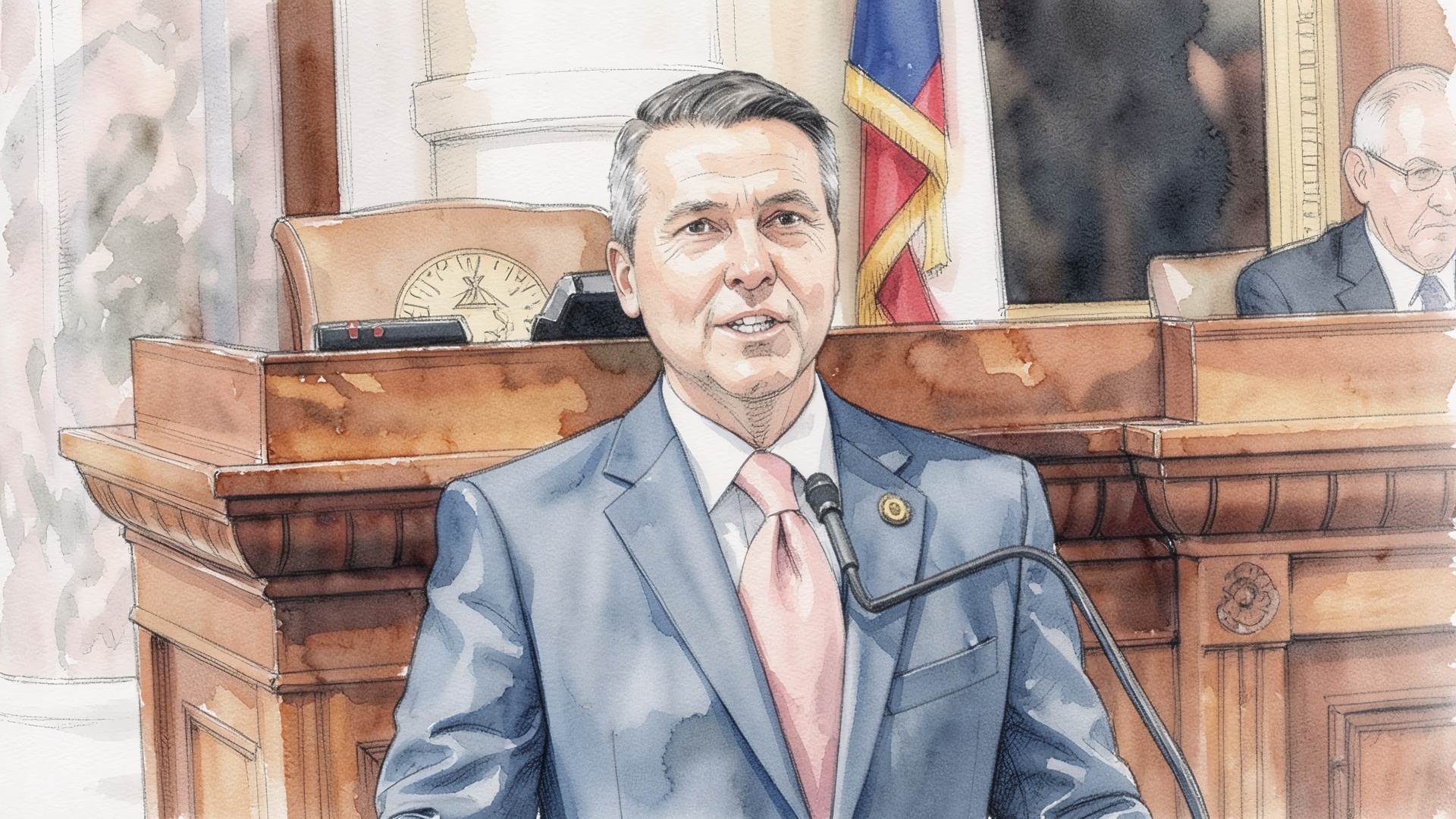
Texas public schools face declining enrollment, lingering learning loss from the pandemic closures, and now artificial intelligence in classrooms. State Rep. Brad Buckley, Chairman of the Texas House Public Education Committee, says the enrollment decline is a particular concern.
During the latest House Public Education Committee hearing, Commissioner Mike Morath told the committee that Texas public schools lost 76,000 students this year and some analysts are projecting bigger losses next year.
According to Buckley, several factors are driving the trend. “The birth rate is part of it,” Buckley says. “In some districts, it’s property values that are so high where young families can’t afford to move into that district.” He also points to homeschooling, virtual education, and charter schools as alternatives families increasingly choose.
Buckley says it is a “convergence” of these factors that has resulted in the declining enrollment.
On housing affordability, Buckley says some neighborhoods are pricing out young families entirely. “That neighborhood school could potentially have real trouble with enrollment because there are no kids there,” he says.
Since public school funding in Texas is tied to enrollment, as it declines, school districts face reductions in baseline revenue.
Buckley says lawmakers are studying how to soften the financial impact on districts experiencing declines. “Our funding formula is really not built around declining enrollment,” he says. “For schools, it’s harder.” He says lawmakers are examining whether increased per-pupil funding could offset some enrollment losses as districts adjust facilities and staffing.
For the long-term, declining birth rates are the biggest challenge for Buckley. “This birthrate thing is not going to change,” Buckley says. “It’s worldwide.” He warns that lower birth rates will affect higher education, workforce development, and programs like Social Security. “That’s the pipeline,” he says. “That’s just fewer people to do the task and have the careers that we’ve typically built our society around.”
Artificial intelligence was discussed as another major topic during the committee hearing. Buckley says lawmakers are trying to determine the “appropriate use of artificial intelligence in a classroom.”
He believes teachers must remain at the center of instruction. “Quality learning takes place when a great teacher stands and delivers in front of kids in an engaging way,” Buckley says. “If AI supports that, that’s one thing. But if AI drives that, that’s another.”
Buckley worries AI could weaken deep learning if students or teachers rely on it too heavily. “Artificial intelligence can make your breadth of knowledge a mile wide, but only a half an inch deep,” he says. He argues students still need “productive struggle” to fully understand difficult concepts.
Age appropriateness also matters. Buckley says younger students still need foundational skills developed without overreliance on devices. “I wouldn’t want to give a third grader a calculator to learn their times tables,” he says. “That’s just what I call walking around knowledge.”
After the pandemic, Buckley says Texas has seen improvements in reading, though math scores still lag. He says the state policymakers, like the Texas Education Agency, are trying to apply more evidence-based approaches in mathematics instruction, similar to reforms already used in reading education. “We have proven in reading and mathematics that there are better ways to do it,” he says.
Buckley also defended the decision to replace the STAAR exam with shorter assessments spread throughout the school year beginning in 2027-28. He says the current model creates unnecessary pressure. “It’s one big test that’s looming at the end of the year,” he says.
The new system would provide faster feedback and allow teachers to track student growth throughout the year. “There’s more teaching time and there’s less anxiety,” Buckley says. “This is a better model.”