
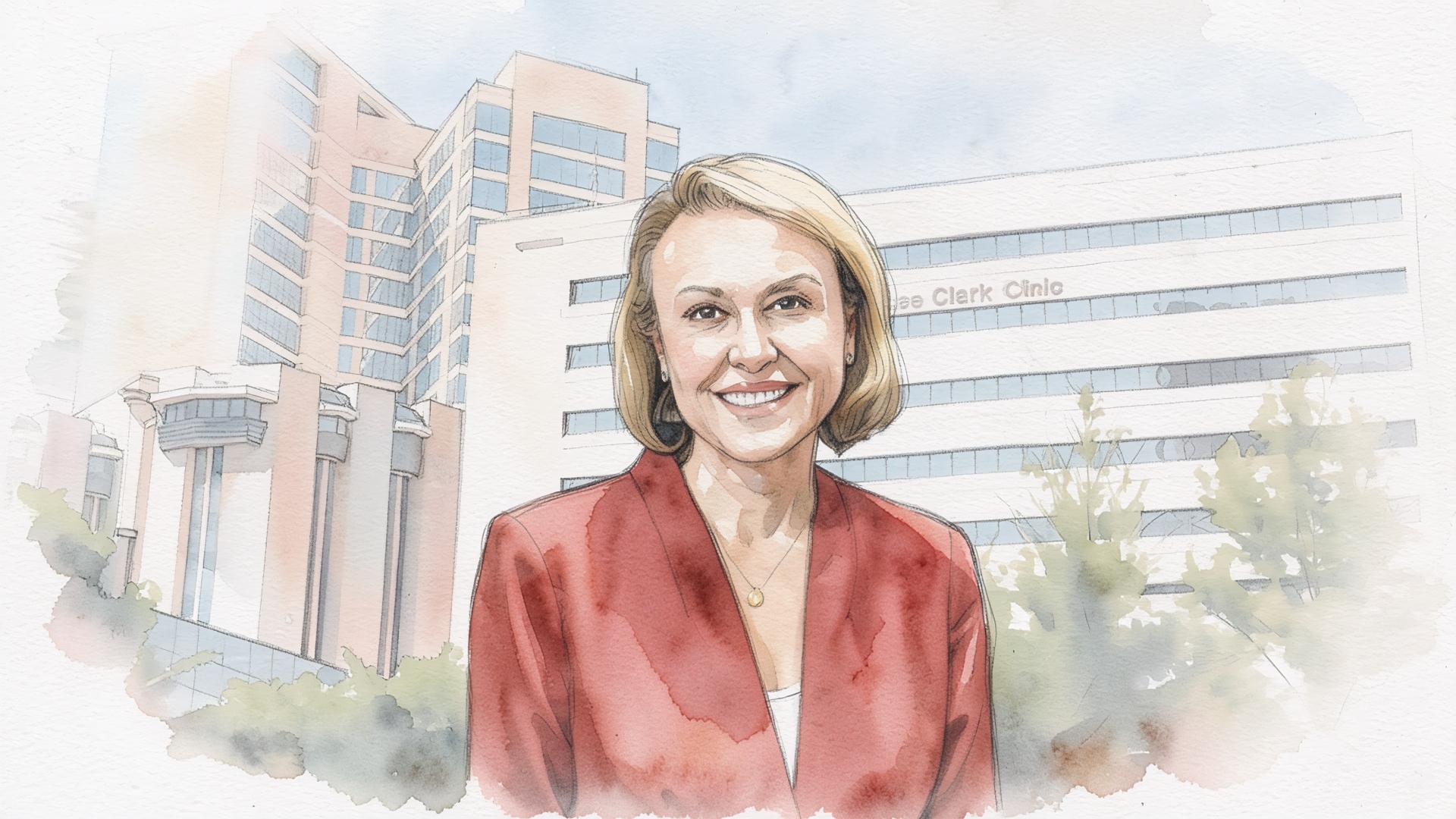
In January 2005, Kristen Doyle was a 32-year-old utility lawyer at the top of her game. She had made partner at an Austin law firm, the legislative session was just getting underway, and she had run five miles that morning. All she wanted from her doctor was antibiotics for a sore throat — over the phone, if possible, because she and her husband, both lawyers with a five-year-old son, had daycare to figure out.
The doctor insisted on seeing her. It wasn’t strep, but her glands were swollen, so she left some blood for a mono test and went back to work. “This can’t be mono, I feel great,” Doyle remembers telling her. That night, the doctor called: come in tomorrow morning, before I see patients. And bring your husband.
The diagnosis was leukemia. She was given the names of three oncologists and told that if she couldn’t get in with one that day, she should go to the emergency room that night. By that evening, she had started chemotherapy.
Twenty years later, Doyle runs the Cancer Prevention and Research Institute of Texas — CPRIT — the state agency that has made Texas the largest public funder of cancer research in the country after the federal government. The through line from that January morning to the CEO’s office is the thing she says drives her still: “There were so many people who were getting the exact same treatment that I was that didn’t survive. And I really want to take the luck out of surviving cancer.”
Doyle had luck in abundance, and she can itemize it like the lawyer she is. Genetic testing — unavailable a generation earlier — revealed a translocation in her cancer that meant standard chemotherapy wouldn’t hold, so doctors fast-tracked her for a bone marrow transplant instead of waiting for a relapse that would have found her weaker. Her chemotherapy regimen, hyper-CVAD, had been developed at MD Anderson only about a decade before she needed it. And her younger sister, a nurse, was a match.
“She saved my life,” Doyle says. Then, because gratitude and sibling rivalry are not mutually exclusive: her sister’s marrow now makes her blood cells, which changed Doyle’s blood type. “She dragged me down from A-positive to A-negative,” she jokes. “It’s okay. It’s still an A.”
Austin had no bone marrow transplant program then, so Doyle spent three months in Dallas, her mother at her side. On the drive home down I-35, her mother — who had worked the pediatric floor at the University of Iowa Hospital as a young nurse, where every child in the state with cancer was sent — told her something Doyle has never forgotten. “Every child who was on my floor that had leukemia, they died,” she said. “And here we are 30 years later, and you have been cured. I just can’t believe that I have seen that in my lifetime.”
Doyle never planned any of this. Born in Cincinnati, she moved to Plano as a high school junior, went back to the Midwest for college at Indiana University, and chose the University of Texas School of Law over Georgetown mostly because it was, in her words, a fantastic bargain.
The plan was three years in Austin, then Washington. Instead she met her husband, built a utility law practice at Lloyd Gosselink during the deregulation of the Texas electric market, and made partner. Her parents and sister eventually followed her to Austin; all live within a quarter mile. “All I ever wanted to be was a lawyer,” she says. “If my parents were here, they would say I showed an early aptitude for arguing.”
Cancer redirected the arguing. After returning to work — she left the office on January 19 and came back September 1, because litigation doesn’t do part time — Doyle joined the board of the Leukemia and Lymphoma Society and started dropping by Capitol offices on its behalf between meetings for her utility clients. In 2007, when Texans voted on the constitutional amendment creating CPRIT with $3 billion for cancer research, Doyle stood in line for over an hour on election night with her husband and son, her hair still growing back, to vote for it.
When the new agency needed a general counsel in 2009, she gave up her partnership — and took a six-figure pay cut — to take the job. “I did bring my kind of cold, dark, cynical lawyer heart to it,” she says of the agency’s early days, insisting on rules and contracts that let the state claw back money not spent as promised. Every grant CPRIT makes must first be recommended by scientific peer reviewers, all of whom live and work outside Texas — a structure she credits with protecting the agency from any appearance of becoming a political slush fund.
As the agency’s only lawyer for years, she also learned that colleagues avoided the general counsel’s office unless something was wrong. Her solution was candy bowls — kept full, so people had a reason to wander in before a problem became the only reason.
When she became CEO in July 2024 and made the unpopular decision to bring staff back to the office after years of remote work, the candy came out of her office and into the common space, next to a coffee station she pays for herself. “Every dollar that we are spending on our operations is a dollar we’re not spending on grants for prevention and research,” she says.
The results of the experiment Texas voters started in 2007 — and renewed with another $3 billion in 2019 — have a scale that surprises even people who follow state government. CPRIT has funded more than 450 clinical trials enrolling over 70,000 patients, committed more than $850 million to 78 Texas companies working to carry discoveries across what researchers call the valley of death — the funding gap where promising ideas die between the laboratory and the marketplace — and supported prevention programs in all 254 Texas counties.
Screenings for uninsured and underinsured Texans have detected more than 60,000 cancers and precancers, many at stages where treatment adds decades of life. “If it were easy to cure cancer, we would have cured cancer,” Doyle says.
The model has become a template. When lawmakers proposed a $3 billion dementia research institute last session, backers pitched it simply as CPRIT for dementia, and voters approved it in November. Doyle — whose own mother-in-law once ran for governor of Texas as a libertarian, and who says she is well acquainted with the view that government has no business in this arena — points out that both measures passed with broad bipartisan support. “This truly is Texas,” she says. “Here’s a huge problem that’s affecting everyone. We will take it on and we will make a difference.”
For Doyle, the legacy question isn’t personal. She wants every Texan who took the leap — every voter who waited in line, as she did with her hair growing back — to own what it built. The luck that saved her life was manufactured by other people, years in advance. Now it’s her job to manufacture more of it.