
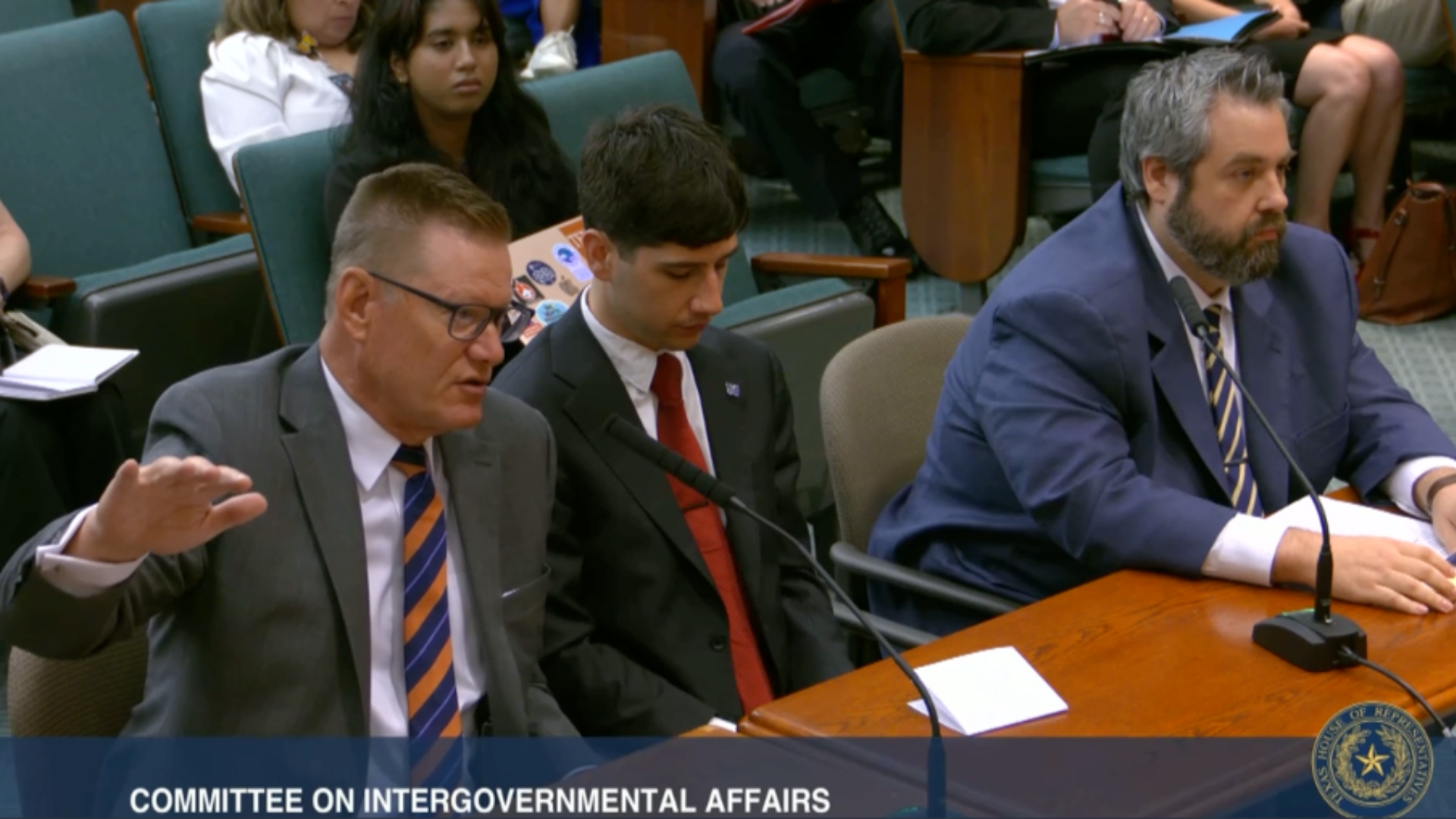
For most of a seven-and-a-half-hour hearing Wednesday, witness after witness told the House Committee on Intergovernmental Affairs the same thing: Texas keeps paying to jail people whose real problem is untreated mental illness, addiction or homelessness, and the bill keeps coming back.
“When individuals with serious mental illnesses, substance use disorders, homelessness, trauma cycle through our law enforcement contact, emergency rooms, jails and courts, our communities are not becoming safer. People are not getting better,” one witness on a criminal-justice panel testified, laying out jail costs that ran, by his county’s count, to “almost $20 million a month.” His conclusion: “We cannot arrest ourselves out of this situation.”
The committee, chaired by Rep. Cecil Bell Jr., R-Magnolia, spent the bulk of its day on a single interim charge — the tangle of mental health, homelessness and what the Legislature calls “system recidivism” — taking invited testimony only as it builds a record ahead of the 90th Legislature in 2027. “We’ll be discussing the interim charges assigned by the speaker of the Texas House, Dustin Burrows, specifically as to how we, as a state, intend to treat and prevent homelessness,” Bell said in opening the hearing.
Members made clear early that they saw a single charge hiding three hard problems. “Y’all are all subject matter experts here, presumably,” said Rep. David Spiller, R-Jacksboro. “This panel, it looks like we’re really talking about three separate issues, whether it be mental health, homelessness, and recidivism. They’re all related, but they’re all separate.” That framing — and the question of which lever the state should pull first — ran through the day.
The opening witnesses pressed for tougher tools. Paul Webster, a senior fellow at the Cicero Institute who described himself as “a subject matter expert on homelessness, particularly the Federal Continuum of Care program,” appeared alongside colleague Jacob Dupuis, and John Bonura, a policy analyst with the Texas Public Policy Foundation, to argue for more state authority over local homelessness spending and stricter accountability.
That drew a pointed question from Rep. Sheryl Cole, D-Austin, who warned against pushing new mandates onto local governments. “I wanted to focus on your comments about accountability and auditing,” Cole said. “I wanted to understand better what you would be thinking about imposing on our cities, who are already cash strapped. And as in the city of Austin, we have the city auditor, and we’re facing a petition for an audit too.”
A second panel — B.J. Wagner of the Meadows Mental Health Policy Institute, Brian Erickson of the telehealth provider Avel eCare, and Steve Autry of Dallas County — turned to what works in place of a jail cell, including pre-arrest diversion and alternatives to inpatient hospitalization.
Rep. Jon Rosenthal, D-Houston, singled Wagner out: “Your testimony is a model for how people should testify in front of [the committee].” Rep. Shelley Luther, R-Tom Bean, pushed the panel to point to a working model elsewhere. “Is there a state that’s doing this better?” she asked. “Is there a state that we can look at their system and say they’re doing it [right]?”
Big-city officials brought the local strain into the room. Larry Satterwhite, director of public safety and homeland security for Houston, testified on behalf of Mayor John Whitmire; David Gray, who leads homeless strategies and operations for Austin; and Dr. Andrea Guerrero, public health director for Bexar County, described programs that move people out of repeated jail and emergency-room contact. Rep. Erin Zwiener, D-Driftwood, the panel’s vice chair, drilled into how the cities measured success, questioning a data window that ran “from 2007 to 2025 for Austin” and asking who was actually returning to homelessness versus exiting it for good.
Not every member accepted the numbers at face value. Rep. Carl Tepper, R-Lubbock, repeatedly demanded harder figures. “All the testimony so far has been speculation,” he said during one exchange over per-inmate jail costs. Later, questioning Austin Police Chief Lisa Davis, Tepper invoked the “revolving door” of repeat arrests that he said keeps her department “in the news.”
Rep. Cassandra Garcia Hernandez, D-Farmers Branch, pressed witnesses on whether a “population audit” was realistic and on rural funding gaps, while Rep. Philip Cortez, D-San Antonio, told the Houston delegation he was struck that “it seems like you have multiple avenues here” for diverting people before arrest.
Law enforcement witnesses, including Chief Davis, a Georgetown police chief, and the Brazoria County sheriff appearing for the Texas Sheriffs’ Association, described officers responding again and again to the same people in crisis. Advocacy and provider witnesses — Amber Honsinger of the Harris Center for Mental Health and IDD, Isidro Torres, interim executive director of NAMI Texas, and Ramey Heddins of MHMR Tarrant County — pushed for more high-acuity psychiatric beds and better data-sharing so that people leaving jail are connected to care rather than released into the same cycle.
The committee took no vote; the hearing was an interim fact-finding session. Bell signaled the testimony would feed legislation when lawmakers return in 2027, building on years of state attention to mentally ill defendants in county jails, including the 2017 Sandra Bland Act’s jail-screening and diversion requirements.
Also at the hearing
The committee devoted the rest of its day to its two other charges. It spent roughly an hour and three-quarters on preventing homelessness among young people aging out of foster care, hearing from state commissioners, providers and former foster youth on the federal Foster Youth to Independence voucher program. A shorter closing block covered agency oversight of the four agencies in the panel’s jurisdiction, including the Commission on Jail Standards and the Texas Commission on Fire Protection.
Archived video: house.texas.gov/videos/22726