
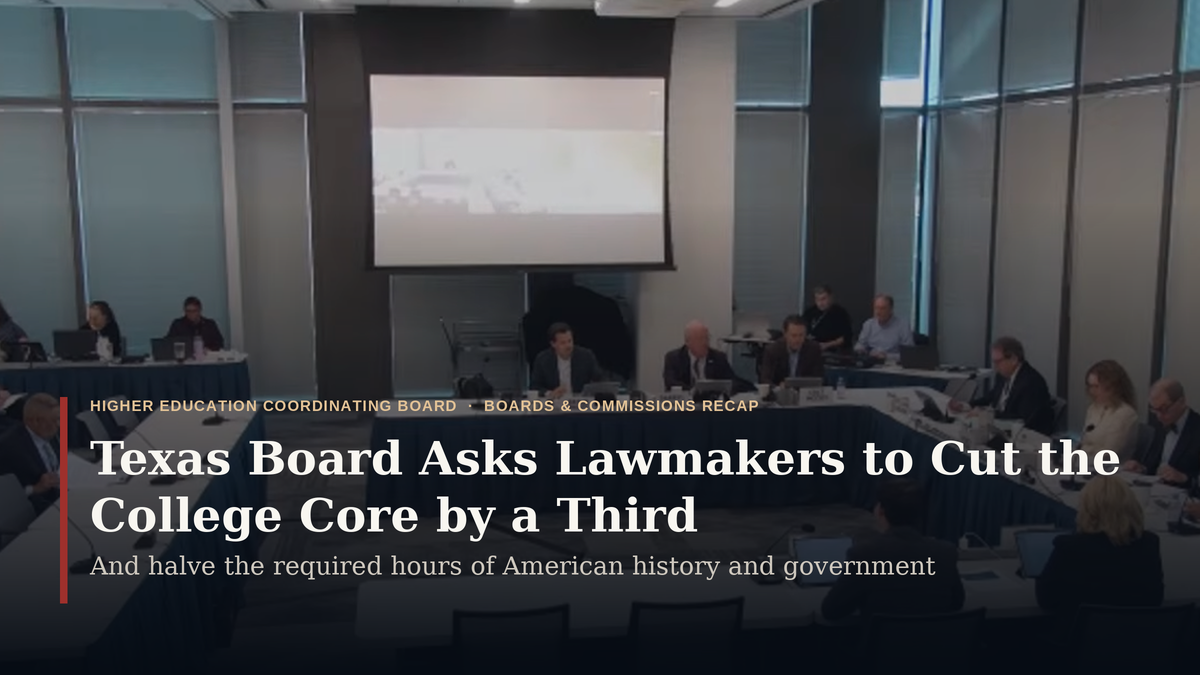
The Texas Higher Education Coordinating Board voted Nov. 16 to recommend that the Legislature cut the core curriculum, the set of courses every undergraduate at a public college must finish, from 42 semester credit hours to 30. If lawmakers agree, students would face half as much required American history and half as much required government, and four fewer required courses in all.
The review was ordered by Senate Bill 37, the 2025 law that overhauled university governance and directed the board to find ways to reduce required hours. Texas requires the largest state-mandated core in the country, the board’s report says, with more than 13,000 courses counting toward it statewide.
The board cannot make the change by itself. The 42 hours sit in state law as a floor, and while the board may approve a different number for a single institution, or a smaller core for associate degrees, a statewide 30-hour requirement takes an act of the Legislature (§61.822). Campuses are already moving: UT Austin has adopted a 36-hour core that needs the board’s approval under that section, and Texas Tech, Texas A&M and the University of Houston have trimmed the courses that count.
The case for cutting is money students have already spent. In fiscal 2024, Texas public colleges refused to count 247,022 semester credit hours that transferring students had earned and paid for, an estimated $41.2 million in a single year, of which about $25.3 million came out of students’ own tuition and fees. Roughly three-quarters of the courses denied were core courses. About 48 percent of students moving from a two-year college to a four-year university were denied credit for three or more courses, which the report calls nearly a semester.
Those losses are not evenly spread. Community college students who transfer tend to be the first in their families to attend college and to have less money behind them, a committee member told the board, and so “the margin for error is smaller” for them. Students taking college courses while still in high school, through dual credit, hit the same wall, the report says.
The sharpest single change is to civics. Texas now requires six semester hours of American history and six of government, 12 in all, set by two separate statutes: history in §51.302, government in §51.301. The report would halve that statutory total to six, folding three hours of each into a new nine-hour block it calls Civic Foundations and spending the third slot on a subject the core does not now contain: global economic systems and personal finance.
The cut is smaller than the hour count suggests. History and government are 12 of 42 required hours now, about 29 percent of the core; Civic Foundations would be nine of 30, or 30 percent. What shrinks is the share the Legislature names subject by subject, from about 29 percent to 20.
The 12 hours that leave the core do not leave the degree. They go back to the colleges, which would decide what fills them. Board members raised minors, double majors, free electives, and trimming engineering degrees that run past 120 hours back to 120.
The vote itself produced the only change to the plan. Before the board approved it, a member moved to add an instruction to the commissioner: that the communication requirement “must include writing intensive coursework to ensure students develop strong written communication skills through substantive writing assignments.” The board adopted the report as amended, without dissent, on a voice vote.
Asked about the risks, a committee member said programs whose enrollment depends on sitting inside the core will find fewer students walking in: “institutions are going to have to adapt and adjust the supply of their faculty and courses.” Another argued the hour count was never the point— “The magic is around the applicability” — and that credit accepted but not applied to a degree is the real waste.
No Texas faculty group, college association, business organization or legislator appears to have taken a public position on the number of hours; the Dispatch found none. The closest outside voice is not an opponent. In August, Veronica Bryant of the American Council of Trustees and Alumni, which advocates for strong core requirements, called the Texas core “particularly strong” in the Austin American-Statesman, but her complaint was the sprawl of courses that satisfy it, not the hours, the half of the problem the report takes up separately in a recommendation to limit how many courses can count in each subject.
The board must deliver its recommendations to the Legislature by Dec. 31. Lawmakers convene Jan. 12, and the committee told the board it is aiming for the new curriculum to take effect in fall 2029, with a stretch in which students could graduate under either one. The advisory committee that wrote the report goes out of existence Sept. 1, 2027.
A record enrollment, five new doctorates and a rewrite of the private-college rules. Texas higher education enrollment reached a new high of more than 1.72 million students in fall 2026, up about 3 percent, or roughly 50,000 students, on last year’s own record; public two-year colleges added about 27,500 of them, the largest gain in raw numbers. The board approved five new doctoral programs — at Prairie View A&M, Texas Tech, Texas State and two at West Texas A&M — and replaced the entire chapter of rules governing private and out-of-state degree-granting institutions, consolidating the standards those colleges must meet from 24 to 12 and restructuring two subchapters into 14. It also reinstated college-readiness testing for all high school students taking college courses, effective with the 2027-28 academic year, reversing an exemption for those with fewer than 15 college credit hours.