
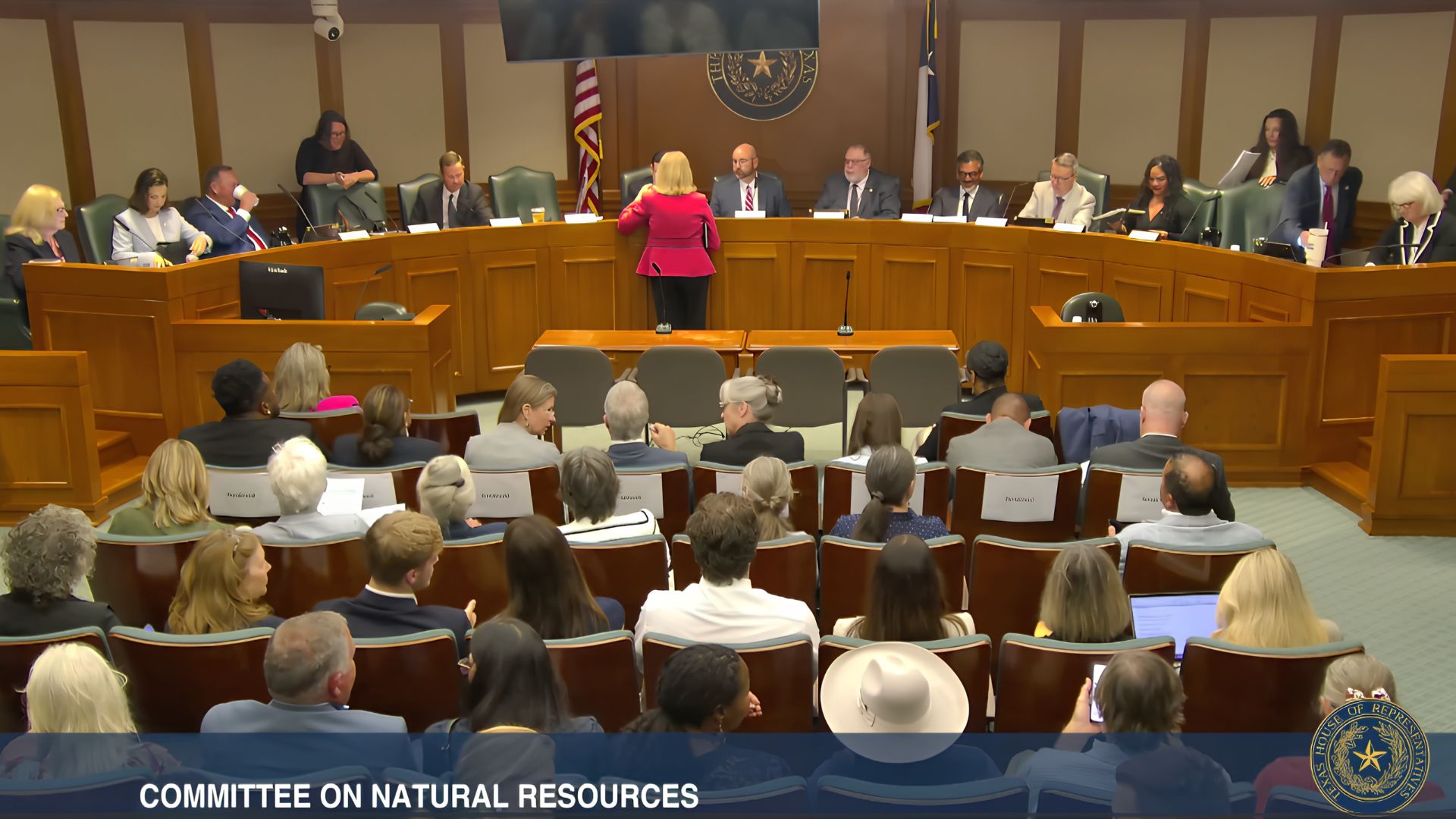
In much of Texas, a data center can sink a well and pump as much groundwater as it wants, and no state agency is empowered to stop it. That was the answer a Texas Water Development Board official gave the House Committee on Natural Resources on Tuesday, when a member asked what happens in a county that has no groundwater conservation district. “There would be no entity in place to regulate that use,” the official said.
The exchange captured the through-line of a hearing that ran almost 10 hours and devoted roughly seven and a half of them to a single charge: the water that data centers consume as they develop across Texas to power the artificial-intelligence boom. Members pressed two questions all afternoon and into the evening — how much water the server farms actually use, and how little the public is allowed to know about it.
The groundwater gap drew the sharpest concern. Chair Cody Harris, R-Palestine said the counties he represents in rural East Texas are “very frustrated with the data centers,” noting that roughly half of them sit outside any groundwater conservation district. In those places, he said, “there is no requirement or obstacle if you’re a data center to overcome to pump as much groundwater as you want.” The board confirmed it: outside a district, no one regulates the pumping.
Secrecy was the other flashpoint. Chair Harris asked two county officials whether anyone in their counties had been asked to sign nondisclosure agreements by data-center developers. “We have not been asked to, nor would we,” one answered. The agreements still surfaced repeatedly. In one exchange about a project near Cedar Creek Lake, a member recalled a county commissioner who was “approached to sign an NDA, and she refused to sign an NDA, and then they stopped communicating,” calling it “a prime example of how not to go about doing a data center project.” A public witness was blunter still: elected officials “cannot be signing NDAs when it comes to our water.”
Industry witnesses pushed back on the premise that data centers are inherently thirsty. Dan Diorio of the Data Center Coalition and representatives of Amazon Web Services and other operators argued that cooling can be efficient and is getting more so. “More data centers are using reclaimed municipal wastewater or recycled water for cooling rather than potable water,” one witness testified, and the best approach “depends on local factors” such as climate and humidity — what works in a humid district, he said, is not what works in the dry Panhandle. Operators described closed-loop systems that recirculate the same water for months before discharge.
Members were unconvinced that efficiency alone answers the question. Rep. Erin Zwiener, D-Driftwood, pressed witnesses on the “inverse relationship between the amount of water required and amount of energy required for cooling,” asking whether the data could pinpoint a “sweet spot” that minimizes total water use. Others pushed on what contaminants build up in recirculated water “whether it’s for data center, bitcoin mining or any other industrial application,” and what treatment is required before it is released.
Conservation advocates urged the state to require disclosure and conservation rather than trust voluntary efficiency. Rachel Haynes, policy director of the Greater Edwards Aquifer Alliance in San Antonio, thanked the committee for its focus on water and pressed for transparency rules. Residents from Parker County and other fast-growing areas testified into the evening.
Harris signaled the issue is headed for legislation. The committee, he said, will “focus largely on data acquisition for groundwater districts and groundwater in general” when lawmakers reconvene. Because the panel met in the interim, it took no vote; any new disclosure, permitting or groundwater rules for data centers would be filed in the 2027 session.
Also at the hearing
The morning’s first three charges covered the state’s water money. Officials reported that the Water Development Board has about $1 billion in one-time appropriations to deploy, that its flagship SWIFT program has run “ten times” oversubscribed, and that the rollout of Proposition 4 — which dedicates up to $20 billion to water over two decades — is on the clock for 2027.